 90%
90% 75%
75% USA
USA Canada
 Australia
 UK
UKGuide to Self-Exclusion at Online Casinos

Disclosure: Our mission is to connect you with the best gambling sites and informational resources available. If you click one of the links on our site, we may earn a commission payment at no extra charge to you. For more information, see our affiliate disclaimer and editorial policy.
Self-exclusion is a responsible gambling tool that allows players to close or block access to their online casino accounts on a long-term basis, including permanent account closure. Responsible gambling depends on having the right tools in place to stay in control, and sometimes that means stepping away completely. There are also shorter options like cooling-off periods to give players a temporary break without permanently closing their accounts.
This guide covers how self-exclusion works, how to use it, and how it compares to short-term cool-off periods.
What is Self-Exclusion?
Self-exclusion is a responsible gambling tool that allows players to ban themselves from an online casino on a long-term basis or to request full account closure. Once activated, you lose access to your account, can’t place bets, and won’t receive marketing communications from the operator.
Unlike cool-off period limits, self-exclusion is designed as a long-term or permanent solution. In many regulated markets, it’s treated as a serious commitment, with strict rules in place to prevent easy reversal and to protect players from impulsive decisions. This often helps players prevent chasing losses, which is a common issue many players face. Learn more about steps you can take to recover from gambling losses.
Self-Exclusion vs. Cool-Off Periods
Self-exclusion and cooling-off periods both allow you to restrict access to your online casino account, but they differ in how long and how strictly that access is blocked. If you’re not ready to commit to permanent closure, cooling-off periods offer a more flexible way to take a break before considering self-exclusion.
| Tool | Permanent or Temporary? | Time Period | Is it Reversible? | Who It’s Best For |
|---|---|---|---|---|
| Self-Exclusion | Permanent | Indefinite | Yes, but reversing self-exclusion is difficult | Players that need to take a permanent break from gambling |
| Cool-Off Period | Temporary | 24 hours–6 months | Not usually | Players that need to cool off and stop gambling for a short period of time |
How to Use Self-Exclusion Tools
You can usually find self-exclusion options within your account settings under sections like “Responsible Gambling,” “Safer Play,” or “Account Controls.” Many casinos also include direct links on their websites to make these tools easier to access.
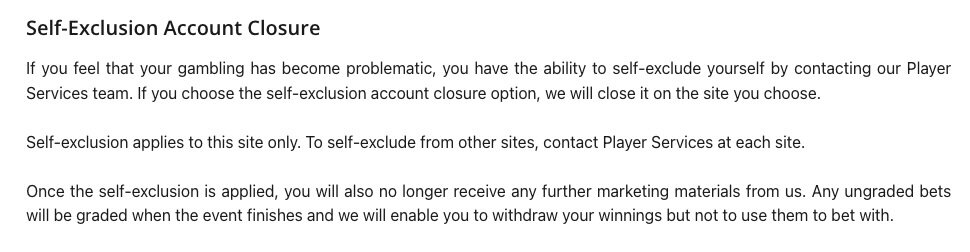
To activate self-exclusion, log into your account and navigate to the responsible gambling section. From there, select the self-exclusion option and choose your preferred action, which may include permanent account closure or short-to-medium-term exclusion periods such as 24 hours, six months, or one year. Once confirmed, the restriction is typically applied immediately, and your account is locked.
Cooling-off periods are also available on most regulated platforms and are worth understanding before committing to full self-exclusion. These are shorter breaks, often ranging from 24 hours to six months, where your account is temporarily suspended. They’re useful if you want time away from gambling without permanently closing your account.
Some platforms have cool-off periods built in to the responsible gambling section of your account, while others require you to contact customer service to enable them. In some cases, especially with permanent closures, you may need to confirm your request through email or live chat to finalize the decision, as it the case at Wild Casino.
Can You Remove Self-Exclusion?
Self-exclusion isn’t designed to be easily reversed. While it may be possible to request account reactivation after a set period, many operators enforce strict waiting periods and additional checks before allowing access again. This is intentional and helps prevent impulsive decisions that could lead to harmful gambling behavior. If you’re unsure about long-term closure, consider using cooling-off periods first to gauge whether self-exclusion is right for you.
Why Players Should Use Self-Exclusion
Self-exclusion is one of the most effective ways to stop gambling activity completely when it’s no longer under control. It revokes access, reduces temptation, and creates a firm boundary that doesn’t rely on willpower alone. For less restrictive control, players can also set deposit limits to manage how much they fund their accounts over time.
Key reasons to consider self-exclusion include:

- Completely blocks access to gambling accounts and betting activity
- Prevents chasing losses
- Stops promotional emails and marketing that could trigger play
- Creates space to reset and reassess your relationship with gambling
- Acts as a strong safeguard for long-term financial and emotional wellbeing
Even for experienced players, having the option to fully step away is important. It’s not just about limiting losses, it’s also about making sure your overall relationship with gambling remains healthy.
Responsible Gambling & Self-Exclusion
Self-exclusion lets you voluntarily block access to gambling websites for a set period or, in some cases, permanently. Depending on the operator, exclusion periods may range from several months to multiple years, and access generally cannot be restored until the selected period ends.
These tools can be useful when gambling becomes difficult to control or when other limits no longer feel effective. Problem gambling can cause personal, financial, and professional harm, so consider combining self-exclusion with support from a responsible gambling organization.
The following resources are available to provide support and help you take greater control of your gambling.
Self-Exclusion FAQs
You lose out. Operators can void any winnings, close your account, and refuse to refund deposits or losses. At physical casinos, staff can remove you for trespassing once they confirm your name on the exclusion list.
Tools like BetBlocker, Gamban, and GamBlock block thousands of gambling websites and apps across your phone, tablet, and computer. Many are free, install in minutes, and let you set how long the block lasts.
You wait for your chosen term to end, then submit a formal reinstatement request. Many programs add extra steps, such as a waiting period, an in-person or video meeting, and identity checks before restoring access.
For many problem gamblers, yes. Self-exclusion removes easy access and cuts marketing triggers, which reduces how often they gamble. It works best combined with blocking software, deposit limits, and support rather than relying on willpower alone.
Not easily. Self-exclusion is built to resist impulsive reversal, so most operators enforce the full term you chose. Some let you request reactivation afterward, but only after waiting periods and extra verification checks.
If gambling feels out of control, yes. It creates a firm barrier that does not depend on willpower, blocking access and stopping marketing. For a shorter test first, try a cooling-off period before committing.
Make Your Play Safer With Self-Exclusion
Self-exclusion is the most decisive responsible gambling tool available, giving players the ability to fully step away from online casinos when needed. Whether you choose permanent account closure or start with a shorter cooling-off period, both options help create distance from gambling and reduce risk.
Before signing up with any online casino, it’s worth reviewing the responsible gambling tools they offer and how accessible they are. Most operators make it easy to take breaks, set limits, or self-exclude when necessary. Taking a few minutes to understand these features can make a big difference in keeping your play safe and controlled.