 90%
90% 75%
75% USA
USA Canada
 Australia
 UK
UKGuide to Play Online Poker: Games, Strategies, and Tips

Disclosure: Our mission is to connect you with the best gambling sites and informational resources available. If you click one of the links on our site, we may earn a commission payment at no extra charge to you. For more information, see our affiliate disclaimer and editorial policy.
Playing poker online is about much more than having a good hand. There’s bluffing, betting strategy, and knowing when to walk away from a hand that isn’t going your way. Whether you prefer Texas Hold’em, Omaha, or another variation, there’s always something new to learn, and even experienced players have room to improve.
We’ve put together this guide to help you get the most out of playing poker online. You’ll find everything from the basic rules and different poker games to tournament formats, betting strategies, and tips for managing your bankroll. We’ll also cover some of the mistakes that can catch players out, so you can head to the tables with a better idea of what to expect.





How Online Poker Works
The main objective of poker is to win the pot, which contains all the chips wagered during a hand. You can do this by having the best hand at showdown or convincing everyone else to fold. You don’t always need great cards to win, and even pocket aces can be beaten by a much weaker starting hand.
When you’re playing poker online, the software handles the cards and keeps track of the action. The decisions are still yours, though. You’ll be up against other players, so paying attention to how they bet can help you get a read on their hands. Even where you’re sitting at the table matters, as acting later gives you a chance to see what your opponents do first.
We’ll stick mainly to Texas Hold’em as we explain how everything works. It’s a good place to start, and we’ll point out where other popular games like Omaha and Seven Card Stud do things differently.
Hole Cards, Community Cards, and Showdown
In Texas Hold’em, each player receives two private cards, known as hole cards. Five community cards are then dealt face up in the middle of the table. You can use any combination of your hole cards and those shared cards to make your best five-card hand.
Omaha gives you four hole cards, but you must use exactly two of them alongside three community cards. Seven Card Stud works differently again, with no community cards. If two or more players remain after the final betting round, they reveal their hands at showdown and the strongest qualifying hand takes the pot.
Basic Betting Actions: Check, Bet, Call, Raise, and Fold
Your options depend on whether someone has already bet during the round.
| Action | What it means |
|---|---|
| Check | Pass the action without betting, when no bet is outstanding. |
| Bet | Put chips into the pot when no one has bet yet. |
| Call | Match the amount needed to stay in the hand. |
| Raise | Increase the current bet. |
| Fold | Give up your hand and any claim to the pot. |
How Betting Rounds Work
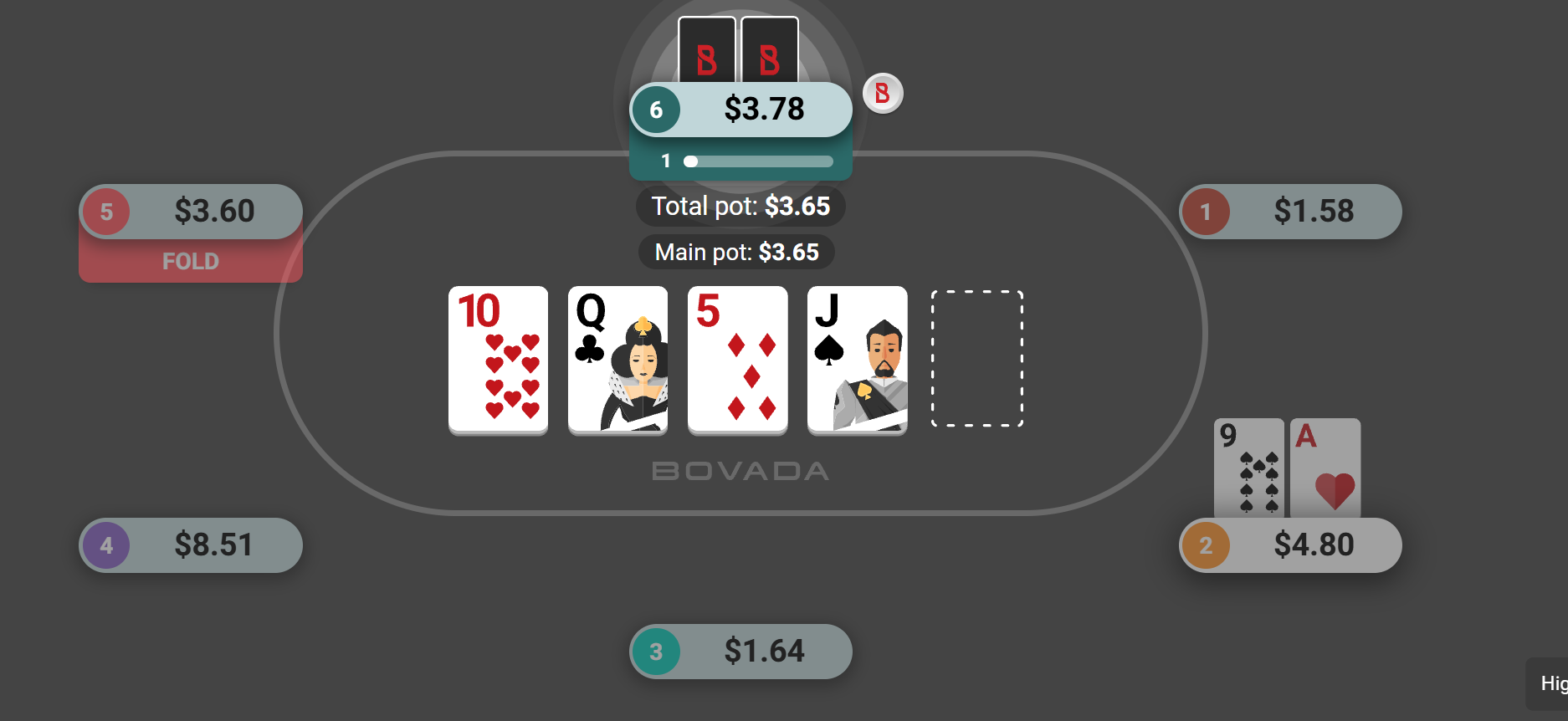
A standard Texas Hold’em hand has four betting rounds:
- Preflop: Players receive their hole cards and act before any community cards appear.
- Flop: Three community cards are dealt, followed by another betting round.
- Turn: A fourth community card is dealt and players can bet again.
- River: The fifth and final community card appears before the last betting round.
If everyone but one player folds at any stage, the remaining player wins without needing a showdown.

Table Stakes Rules
In a table-stakes game, you can only wager the chips you have at the table when the hand begins. You cannot add more chips midway through a hand to cover a bet. If an opponent has more chips than you, you can still go all-in for your remaining stack.

Table Stakes Example
You have $40 and your opponent has $150. If they bet $100, you can call all-in for $40. The extra $60 cannot be won from you and is returned if no other player is involved.
How All-In Bets and Side Pots Work
When players have different stack sizes, an all-in bet can create separate pots. Everyone who has contributed to the main pot can compete for it, but only players who have contributed to a side pot can win that side pot.
Side Pot Example
Player A goes all-in for $20, while Players B and C each wager $50. The first $20 from each player forms the main pot; the additional $30 from B and C forms a side pot.
| Player | Total Wagered | Main Pot | Side Pot |
|---|---|---|---|
| A | $20 | $20 | $0 |
| B | $50 | $20 | $30 |
| C | $50 | $20 | $30 |
| Total | $120 | $60 | $60 |
All three players can win the $60 main pot, but only B and C can win the $60 side pot. Online poker software handles these calculations and awards each pot to the eligible winner.
Types of Online Poker Games
Poker isn’t always about making the strongest hand. Some games of poker split the pot between high and low hands, while others reward the lowest hand possible. A straight is valuable in Hold’em but counts against you in 2-7 Triple Draw.

Texas Hold’em
Texas Hold’em is the most popular poker game in the world and it’s deeply embedded in pop culture. You’ve likely seen it in Rounders, heard it in Poker Face by Lady Gaga, and watched it dominate televised tournaments.
Its appeal comes from a balance of simplicity and depth. Each player is dealt two hole cards, and five community cards are shared. The goal is to make the best five-card hand, or outplay your opponents through bluffing and strategy.
According to TheHendonMob, more than 3,100 players have earned over $1 million in career winnings from this game alone.
Omaha
Often considered Texas Hold’em’s high-octane cousin, Omaha poker deals each player four hole cards, instead of two. You must use exactly two of your hole cards, plus three from the community board, to make your hand.
This small rule tweak creates much more action and complexity. Pot sizes grow fast, making Omaha a favorite among high-stakes players who enjoy volatile, strategy-heavy gameplay.
Omaha Hi-Lo
Also known as Omaha 8 or Better, Omaha Hi-Lo splits the pot between the best high hand and the best low hand (if one qualifies). Players still get four hole cards and must use two, plus three from the board.
This version adds an extra layer of strategy, as you’re playing for two hands at once. With its mix of tactical depth and action, Omaha Hi-Lo is best suited to more advanced poker players.
7-Card Stud
7-Card Stud is old-school poker, with no community cards and no bluff-heavy chaos. Each player gets seven cards total (three down, four up), and the best five-card hand wins.
There’s no flop, turn, or river like in Hold’em, so you have to rely on memory, observation, and tight decision-making.
It’s a slower-paced game but requires more thinking. If you’re a patient player who never loses focus, this might be your ideal poker variant.
5-Card Draw
Five Card Draw is one of the simplest and most beginner-friendly forms of poker. Each player is dealt five private cards, and after a round of betting, can choose to discard and replace some cards to improve their hand.
It’s fast, straightforward, and easy to grasp, making it a great starting point for anyone learning how to play poker online.
Hi/Lo Split-Pot Games
Hi/Lo poker splits the pot between the best high hand and the best qualifying low hand. Under the 8-or-better rule, a low hand needs five different card ranks of eight or lower. Aces count as low, and straights and flushes don’t count against the low hand.
For example, A-2-3-4-5 beats 2-3-4-5-8 for the low half. If nobody qualifies, the best high hand wins the whole pot. Winning both halves is known as scooping.
Omaha Hi-Lo and Seven Card Stud Hi-Lo both use this format. Omaha uses community cards, while Stud players make their best five-card hands from seven cards dealt individually.
Lowball Poker Games
Lowball poker rewards the lowest hand, with rankings that depend on the variant.
- Razz: Aces are low, and straights and flushes don’t count against you. The best hand is A-2-3-4-5.
- 2-7 Triple Draw: Aces are high, and straights and flushes count against you. The best hand is 2-3-4-5-7, with cards of at least two different suits.
Razz follows a Seven Card Stud structure. In Triple Draw, players have three drawing rounds to discard and replace cards.
Best Poker Game for Beginners
Texas Hold’em is a good starting point for online poker. You only need to learn traditional high-hand rankings, without the split pots or alternative hand values found in other games.
- Straightforward rules: Make your best five-card hand using any combination of your two hole cards and the five community cards.
- More ways to play:Choose from cash games, tournaments, and a range of stakes.
- Free practice: Play-money tables and strategy guides help you learn the rules before trying real-money games.
Play-money opponents often take risks they wouldn’t take with real cash. If you move to real-money games, start at low stakes and decide how much you’re prepared to lose before playing.
Online Poker Formats & Structures
From Sit & Gos to Zone Poker, here’s a breakdown of the most popular online poker formats, how they work, and what type of gameplay you can expect.
| Format | Explanation |
|---|---|
| Sit & Gos | Small, fast-paced tournaments that start as soon as the table fills. |
| Cash Games | You can join and leave tables whenever you want. |
| MTTs (Multi-Table Tournaments) | Tourneys with big prize pools, scheduled start times, and lots of players. |
| Zone Poker | Fast-fold poker games. You can fold and instantly jump to a new hand. |
| Heads-Up Tables | One-on-one action, in which the winner takes it all. |
Poker Betting Formats
The betting rules can change how you approach a poker hand. At some tables, you’re restricted to fixed amounts. At others, you can put your entire stack on the line. Limit, No-Limit, and Pot-Limit are the three main formats you’ll encounter online.
Limit Poker
Each betting round has set amounts for bets and raises, rather than letting players choose their own sizes. In Fixed-Limit Hold’em, those amounts double on the turn and river, and most tables cap the number of raises allowed in each round.
With big raises off the table, there’s more emphasis on choosing good starting hands and getting value when you’re ahead. Players can also afford to call more often when the price is small, so bluffing tends to be less effective. Seven Card Stud also commonly uses this structure.
No-Limit Poker
There’s no upper betting limit beyond the chips you have at the table. If your opponent has $100 left, a sufficiently large bet could force them to risk all $100 to stay in the hand. It’s the standard format for Texas Hold’em cash games and tournaments.
Bet sizing becomes a bigger part of the strategy here. A large raise might force someone off a marginal hand, but it can also leave you facing an expensive decision if they raise again. One bad call could cost you your entire stack.
Pot-Limit Poker
The maximum raise is tied to the size of the pot, including any outstanding bets and the amount needed to call. If there’s $50 in the pot and nobody has bet, the most you can wager is $50. As more chips go into the middle, the amount players can raise increases.
Pot-Limit Omaha (PLO) is the best-known example. Players receive four hole cards and must use exactly two to make their final hand. With more possible draws in play, a strong-looking hand can quickly fall behind.
Online Poker Strategies for Beginners
Knowing the rules is one thing, but deciding which hands to play takes practice. Being selective with your starting hands is a good place to begin. Premium hands like A-A and K-K are usually worth playing, but your position at the table matters too. Acting later gives you a chance to see what other players do before deciding whether to get involved, which can make some weaker hands more playable.
Once you’ve got a feel for which hands to play, you can start thinking about how much to bet and whether chasing a better hand is worth the cost.
Value Betting in Poker
Value betting is about getting opponents with weaker hands to put more chips into the pot. Betting too much might scare them off, while a smaller amount could encourage a call. Finding the right size depends on your cards and what you think your opponent is holding.

Value Betting Example
Say you’re holding A-K and the community cards are A, 9, 5, 2, 7, with no flush possible. Your pair of aces beats an opponent holding A-J, so a modest bet could tempt them into calling with their weaker kicker.
You’d still need to be wary of someone holding two pair or three of a kind, though.
Probability Basics: Outs, Odds, and Pot Odds
You don’t need complicated calculations to understand the odds in poker. A few basic numbers can tell you whether chasing a better hand is worth the price.
- Outs: Cards that could improve your hand enough to win. If you have four hearts, for example, there are nine hearts left in the deck that could complete your flush.
- Odds: Your chances of getting one of those cards. With nine outs and one card to come, you’ll complete your flush roughly 19% of the time.
- Pot odds: A way of comparing how much you need to call with how much money you could win.

Pot Odds Example
You’re one heart away from a flush, with only the river card remaining. There’s $60 in the pot, and your opponent bets $20.
Calling $20 would bring the pot to $100, meaning you need a 20% chance of winning to break even. Your chance of completing the flush is roughly 19%, so folding is the better mathematical choice if a flush is your only way to win and no further money can be won.
Why Good Poker Decisions Don’t Always Win
You could go all-in with pocket aces against pocket kings and still lose when the remaining cards are dealt. That’s part of poker. Even when you’re a big favorite, there’s always a chance things won’t go your way.
Poker players call these ups and downs variance. You’ll also hear about expected value (EV), which looks at how much you’d expect to win or lose from making the same decision repeatedly. Getting your chips in with aces against kings generally has positive EV when both players risk the same amount. You might lose this time, but you’d still want to be holding the aces if you played the matchup again.
That’s why it’s worth looking beyond individual results. Losing streaks can happen even when you’re playing well, so keeping your bets within your bankroll is just as important as making good decisions at the table.
Advanced Online Poker Tips
These are your poker commandments to live by at every table, no matter what the stakes might be. Stick to them, and you’ll avoid rookie mistakes and advance your play.
Put Yourself in Your Opponents' Position
One of the tips legendary Phil Ivey revealed in his tutorial was to put yourself in your rival’s shoes. After a hand, ask yourself: If the roles were reversed, would my opponent have lost more, less, or the same? It’s a smart way to measure who’s really in control.
If they would’ve played it better than you, you’re in trouble – maybe it’s time to leave the table? If not, you’re the one who’s got the edge, so start betting big.
Use a HUD
Some online poker rooms let you use the HUD (heads-up display) feature. Basically, this is a tool that shows you real-time stats of the players at your table. For example, you can see how often they fold preflop, raise, call, or go all-in.
This way, instead of playing blind, you’ll be using hard data. For example, if someone folds to 3-bets 90% of the time, you can start 3-betting them with weaker hands and steal pots.
Exploit Anonymous Tables Differently
At offshore casino sites like Bovada or Ignition, players are anonymous, meaning that you can’t track their stats. So, our advice is to assume nothing long-term. Instead, exploit short-term patterns such as multiple limps, auto-checking big blinds, or weird raises.
However, keep in mind that some players might be faking it in order to lure you into a bad hand. For example, some players fake a disconnect and then come back with a big raise to look weak. But that’s not lag, it’s bait.
Common Online Poker Mistakes to Avoid
How to play poker online for money isn’t just about doing certain things. It’s also about avoiding certain mistakes. In the next section, we’ll show you some of the most common mistakes to watch out for.
Auto-Pilot Mode
Online poker moves fast, and it’s easy to click buttons without thinking. But you mustn’t fall into that trap. Every decision in poker needs to have a valid reason.
By “valid” we don’t mean “based on gut feeling.” Instead, we mean a move that’s based on reason. So, if you find yourself clicking “call” without thinking why, it’s time to take a break.
Don't Multitask
With online poker, you can play at multiple tables at once. Sounds great, but it can actually be very dangerous, especially if you’re a beginner. Every poker hand needs to be thoroughly analyzed, and you can’t do that if you’re juggling too many tables at once.
Bluffing
It’s not as essential as movies make it seem. In fact, beginners often lose more chips trying to bluff than they would by just playing solid hands. At low-stakes tables, most players call too much anyway, so your bluffs won’t land. Focus on value betting and strong hands first.
Key Differences Between Online Poker vs. Playing Live
Online poker and live poker follow the same basic rules, but the experience can be quite different. From the pace of play to reading your opponents, here’s how the two compare.
| Game Speed | Fast-paced with 60–100+ hands per hour | Slower pace, typically 20–30 hands per hour |
|---|---|---|
| Player Pool | Thousands of players online 24/7 across all stakes | Smaller, location-based pools; limited by room capacity |
| Multi-Tabling | You can play multiple tables at once | One table at a time |
| Physical Tells | No physical tells — you rely on timing, betting patterns, and stats | You can observe real-life tells like body language and demeanor |
| Accessibility | Play anytime from your computer or mobile device | Must travel to a poker room or casino |
| Stakes Variety | Micro-stakes to high-stakes always available | Limited low-stakes tables; higher rake on small games |
| Bonuses & Rewards | Welcome bonuses, rakeback, and loyalty programs available | Occasional comps (drinks, meals), but fewer structured rewards |
| Atmosphere | Solo, focused, and sometimes anonymous | Social, chatty, and face-to-face |
| Learning Curve | Tougher opponents overall — many use tracking software and HUDs | Softer fields, especially in low-stakes games |
| Game Integrity | Software handles shuffling and dealing — fully automated | Human dealers and physical cards, but with more room for dealer error |
Online Poker Etiquette 101
There are many rules of poker etiquette you just don’t know until you break them. If you can avoid breaking the following rules, you should do just fine at the poker tables – both online and live ones.
Online Poker Term Glossary
Poker has its own language, and some of the terms can be confusing if you’re new to the game. We’ve broken down some of the most common poker terms you’ll come across at the tables and what they mean.
| Poker Term | Explanation |
|---|---|
| Blinds (Big and Small) | Big Blind is the larger of the two forced bets, made by the player two seats left of the dealer. Small Blind is usually 50% of the Big Blind and is placed by the player on the left of the dealer. |
| Rake | A small cut taken from the pot by the house or poker site. |
| All-In | You bet all your remaining chips. It’s a high-risk scenario – if you lose, it’s game over for you. |
| Buy-In | The amount needed to enter a game or tournament. |
| Call | Match someone else’s bet to stay in the hand without raising. |
| Raise | Increase the bet size after someone else has already put chips in. |
| Community Cards | The shared cards that are dealt face-up for all players to build their hands. |
| Flop | The first three community cards, dealt face-up after the first betting round. |
| Hole Cards | The private cards you’re dealt, which no one else at the table can see. |
| Freeroll | A tournament that you can enter for free. There’s no real-money buy-in but the prizes are real. |
Up the Ante and Win at Online Poker
After reading this guide, you know how to play online poker in the US. You know how to start, as well as which strategies to follow to take your game to the next level. The only thing that’s left for you to learn is where to play online poker – our answer is at Ignition Casino.
This site has a standalone poker room with dozens of tables and all kinds of tournaments you can join. There’s even a poker bonus for new players – 150% up to $1,500 – as well as 10+ other deals. Sign up now and grab those bonuses!


