 90%
90% 75%
75% USA
USA Canada
 Australia
 UK
UKCard Games Like Spades: Euchre, Bridge, and Hearts Compared

Spades is a trick-taking classic that took off among American soldiers in the 1930s and spread to households after the war. If you’ve mastered it, you’re already halfway to picking up several other trick-taking games that share its DNA.
You won’t find Spades itself at a live dealer casino. But if you like the mechanics, blackjack, poker, and baccarat scratch a similar competitive itch, and I’ll cover real money options for those below too.
Here are five card games worth trying if you’re a Spades fan looking for something new.
Euchre
Euchre is the closest thing to Spades on this list, and it’s actually the older game. It dates to the 18th and 19th centuries in Europe, and German immigrants are credited with bringing it to the US, where it’s still a Midwest staple today.
A few things separate the two games:
- Players: Euchre is a fixed four-player game with two partnerships. Spades can stretch to six.
- Trump suit: Spades always uses spades as trump. Euchre decides trump hand by hand, based on the top card of the leftover deck after dealing.
- Scoring: Euchre games usually end at 5, 7, or 10 points, well short of the 500-point games common in Spades.
- Card ranking: This is the part that trips people up. Euchre uses a “bower” system, where the jack of the trump suit outranks the ace. It’s not the standard high-to-low order you’d expect coming from Spades.
To win a hand, your team needs to take at least as many tricks as you bid. If you’re comfortable with how bidding works in Spades, Euchre’s version of it will feel familiar fast, the ranking quirks are really the only real learning curve.
Contract Bridge
Bridge is the more cerebral cousin of Spades, and if you want a real strategic challenge, this is where you’ll find it.
Like Spades, Bridge is played with four people in two fixed partnerships seated across from each other, and play moves clockwise. But Bridge uses a standard 52-card deck (Spades is often played with 54, including jokers), and it ranks aces high with no fixed trump suit.
The bidding is what sets Bridge apart. Partnerships bid for a “contract,” a target number of tricks between one and seven, and whichever suit gets named during that bidding becomes trump for the hand. The side that wins the auction has to hit their contract; the defenders are just trying to stop them.
That’s a meaningfully more complex bidding structure than Spades, where you’re mostly estimating your own hand’s tricks. Bridge rewards players who enjoy the strategic depth, but it has a steeper learning curve.
Whist
If Bridge and Euchre sound like too much, Whist is the easier on-ramp. It’s actually the game Bridge evolved from, stripped down to its essentials.
Whist uses a standard 52-card deck and the same partnership format as Bridge, two against two, seated across the table. The big difference from both Bridge and Euchre: there’s no bidding at all. Trump is set once per hand (often just by turning up a card) and stays fixed, similar to how spades are permanently trump in Spades.
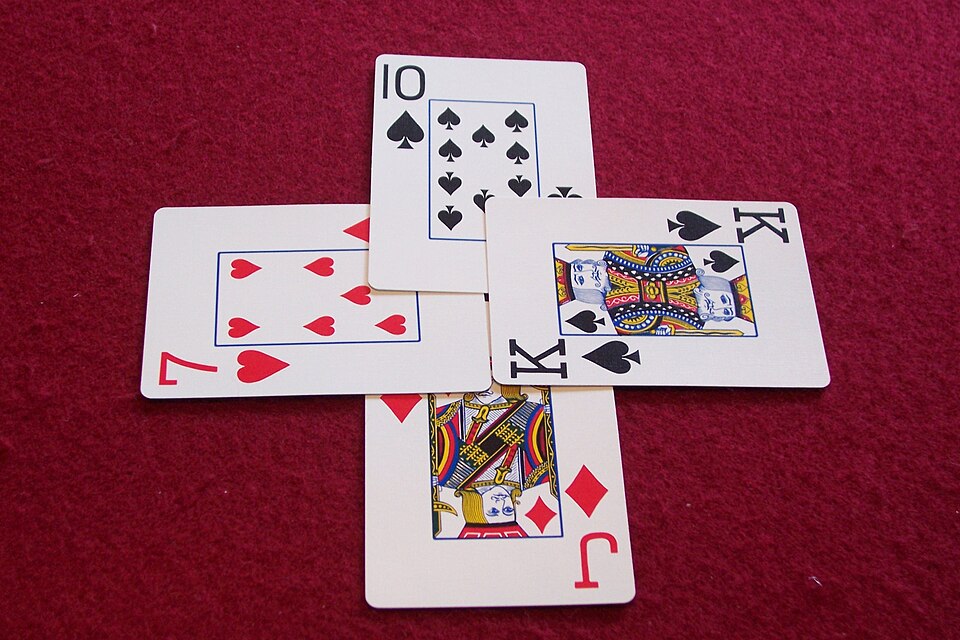
The confusing parts of the other games are typically about the bidding aspects or the trump suits. In Whist, there is no bidding, and the trump suit stays the same. Spades has a similar layout, but again, the trump suit is always a spade.
Card ranking follows the standard order with aces high, and you simply score points for tricks won. There’s no need to estimate anything before play starts, which makes Whist the most beginner-friendly game on this list, easier to pick up than Spades itself.
Pinochle
Pinochle is worth a look if your group runs bigger than four. Some variations support up to eight players, and there are also two-player versions if you’re short on people.
The deck is where Pinochle gets unusual. It uses 48 cards total, built from two decks with the 2s through 8s removed, so you’re playing with duplicate high cards. Aces rank highest.
The objective has two parts. You score points by melding certain card combinations (each combo has its own set value), and you also score by winning tricks. Bidding determines the trump suit: whoever bids highest sets trump and commits to hitting a target combining melds and tricks.
Pinochle takes longer to learn than Spades because of the melding element, but the combination of building card sets and taking tricks gives it more strategic texture once it clicks.
Hearts
Hearts looks like it should be Spades with a different trump card. It isn’t. The core mechanic is inverted.
In Spades, you’re trying to win tricks. In Hearts, you’re trying to avoid certain cards. Every heart you take costs you a point, and the queen of spades costs you 13 on its own. Whoever has the lowest score at the end wins, the opposite of most trick-taking games.
Hearts also drops the partnership format entirely. It plays best with four but works with anywhere from three to six, and everyone is on their own.
Between the low-score-wins scoring and the lack of partnerships, Hearts feels the least like Spades of anything on this list. That’s also what makes it a good change of pace if you want a genuinely different game rather than a variation.
Real Money Spades Alternatives
| Game | Poker | Blackjack | Baccarat |
|---|---|---|---|
| Where to Play | Las Atlantis Casino | Wild Casino | Ignition Casino |
| Welcome Bonus | 280%, up to $14,000 | 250%, up to $5,000 | 300%, up to $3,000 |
| Visit | Visit Las Atlantis Casino | Visit Wild Casino | Visit Ignition Casino |
Blackjack and baccarat are probably the closest fit to Spades in terms of pace and structure, but poker shares the reading-your-opponents element that trick-taking fans tend to enjoy.
All three sites above are established, easy to sign up at, and carry a wide game selection beyond just these titles. As with any online casino, stick to licensed, reputable operators and check what’s legal in your state before you play.
If you like the social, high-energy feel of a Spades table, live dealer games are worth trying too. They put you across from a real dealer and other players in real time, which is the closest a casino floor gets to game night.


