 90%
90% 75%
75% USA
USA Canada
 Australia
 UK
UKLet It Ride vs. Three Card Poker: Two Poker Games, Very Different Bets

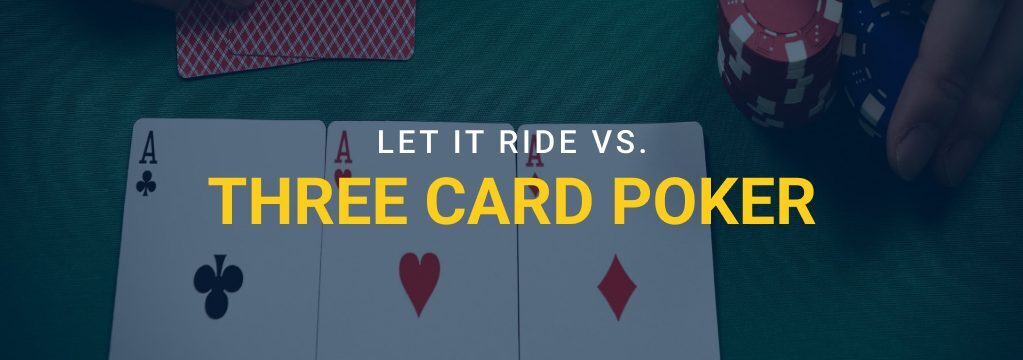
Let It Ride and Three Card Poker both follow traditional poker hand rankings, but they play nothing alike. In Let It Ride, you build a five-card hand from three of your own cards plus two community cards. In Three Card Poker, you and the dealer each get three cards, and the better hand wins.
Here’s how both poker games stack up on rules, payouts, house edge, and strategy.
Let It Ride vs. Three Card Poker at a Glance
Here is how Let It Ride and Three Card Poker compare against each other when it comes to cards used, how the dealer plays, betting mechanics, and how to win.
| Feature | Let It Ride | Three Card Poker |
|---|---|---|
| Cards used | Three player cards plus two community cards | Three player cards against three dealer cards |
| Dealer hand | None; paid by a pay table | Yes; you play against the dealer |
| Starting wager | Three equal bets | One ante |
| Main decision | Pull back or let it ride, twice | Fold, or raise with a Play wager |
| Community cards | Two | None |
| Objective | Make a paying five-card hand | Beat the dealer’s three-card hand |
| Strategy | More decision points | One main decision |
| Side bets | Optional bonus wagers | Pair Plus, and others at some tables |
Here’s what we’ll send you when you subscribe:
- 60 free spins
- A $10 free bet
You can cash out up to $450 in winnings with these bonuses. They won’t stick around long, so hurry and claim these bonuses while you can.
How Let It Ride and Three Card Poker Work
The two games may share poker-style hand rankings, but the action at the table is quite different. Let It Ride is built around forming a five-card hand and deciding how much of your original stake to keep in play, while Three Card Poker puts your hand directly against the dealer. Here’s how a round works in each game.
Playing Let It Ride
You start by putting down three equal bets. You get three cards, and two community cards sit face down on the table. Take a look at your hand, then decide whether to pull back your first bet or let it ride.
Next, one community card is flipped, and you make the same call on your second bet. The third bet stays in play no matter what. After the last card is revealed, your five-card hand is paid out according to the posted pay table. There’s no dealer hand to beat.
Playing Three Card Poker
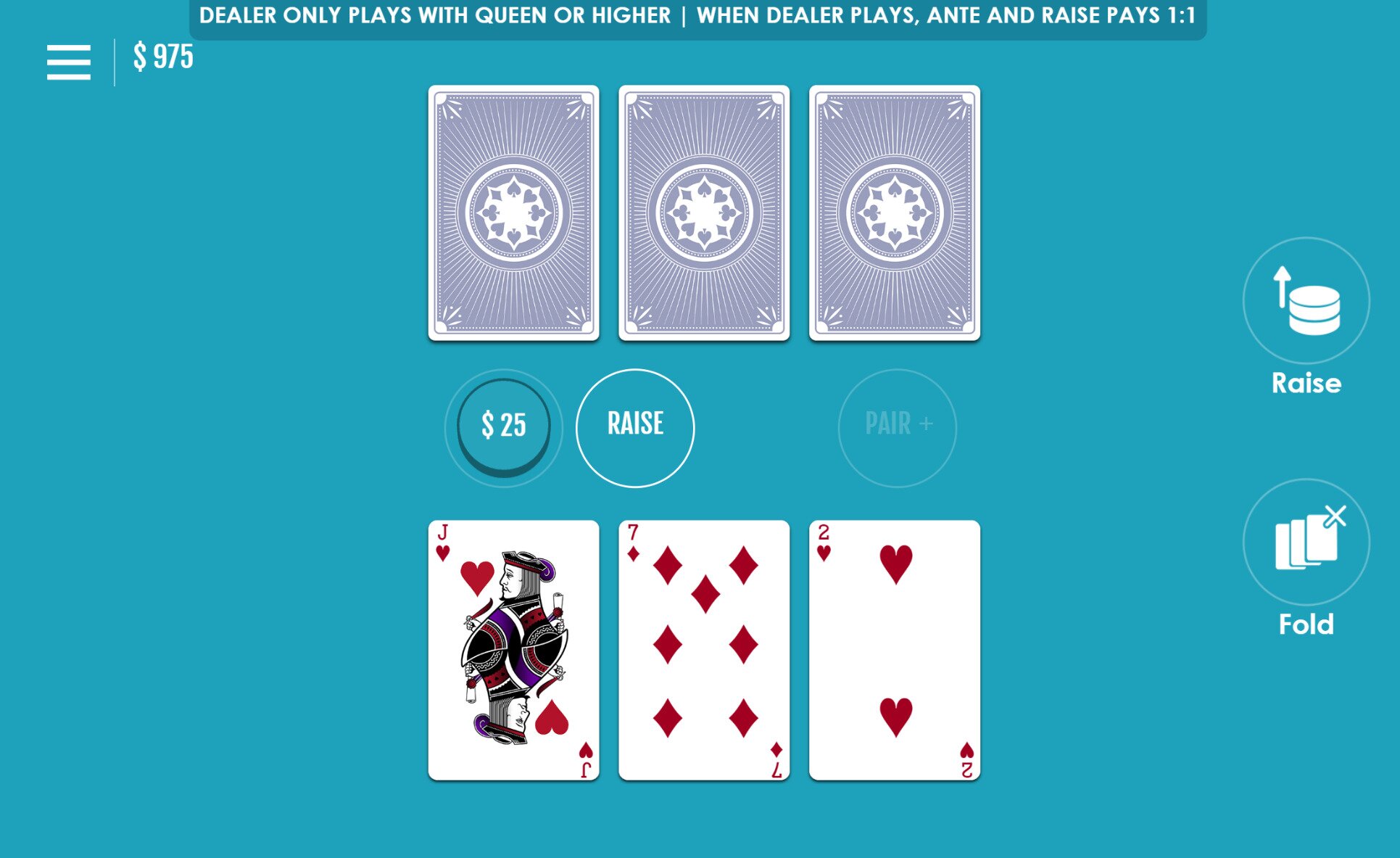
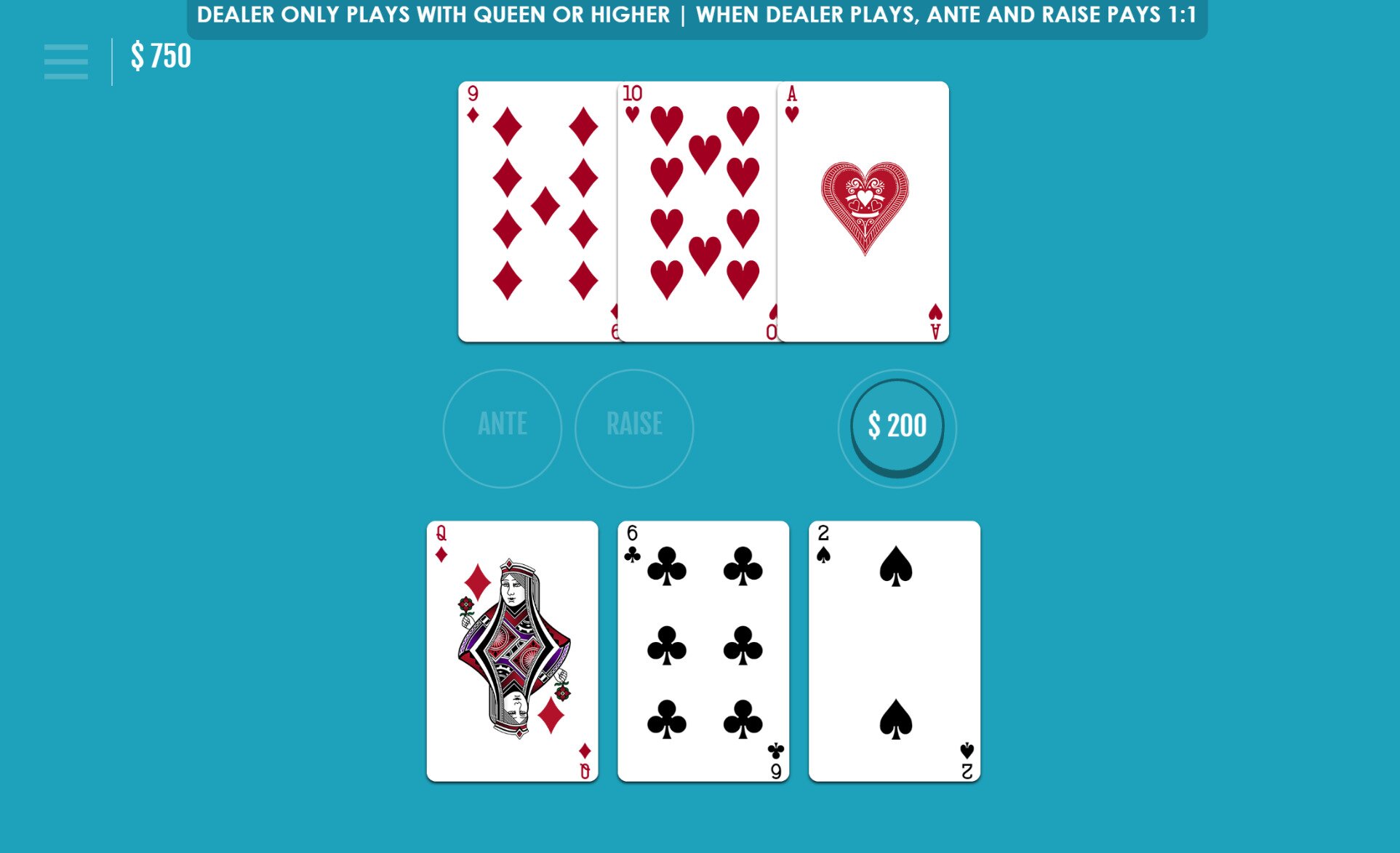
You and the dealer each get three cards and you put an ante in the pot as your initial wager. Once you’ve looked at your cards, you can fold and give up the ante, or place a play wager equal to the ante.
If you play, your hand is compared with the dealer’s. The dealer usually needs queen-high or better to qualify. Pair plus is an optional side bet that pays on your own three-card hand, whether or not you beat the dealer.
The Biggest Differences Between Let It Ride and Three Card Poker
Let It Ride and Three Card Poker start to separate once the cards are dealt. You’re playing toward a different outcome in each game, with different decisions to make along the way. Even the hand rankings aren’t quite the same, which adds another wrinkle to how the two games play.
You’re Playing for Different Outcomes
Let It Ride pays based on the strength of your finished five-card hand. There’s no dealer hand involved, so a pair of 10s pays the same no matter what anyone else is holding.
Three Card Poker’s ante and play bets are mostly a showdown with the dealer. A decent hand can still lose, and a so-so one can win if the dealer doesn’t qualify. So Let It Ride feels like chasing a paying hand, while Three Card Poker feels like a quick head-to-head.
Let It Ride Gives You More Betting Decisions
Let It Ride gives you two chances to rethink how much you have in play as more cards show up. Three Card Poker has one main decision: raise with a play wager or fold.
Either way, those choices change how much money is at risk. They don’t change which cards come out.
The Poker Hand Rankings Are Different
Let It Ride uses the standard five-card rankings you already know. Three Card Poker has its own order for three-card hands: straight flush, three of a kind, straight, flush, pair, then high card.
The odd one is that a straight beats a flush, because three-card straights are rarer than three-card flushes.
Let It Ride vs. Three Card Poker House Edge
House edge is the average amount the casino keeps, shown as a percentage of a bet. The two games count bets differently, so it’s worth looking at the element of risk too, which compares what you’d expect to lose with the total amount you wagered. The short version: on standard pay tables, Three Card Poker’s ante/play bet costs less per dollar wagered than Let It Ride.
| Wager | House Edge | Element of Risk |
|---|---|---|
| Let It Ride (standard pay table, optimal strategy) | 3.51% of one bet | 2.85% |
| Three Card Poker ante/play (ante bonus 5/4/1, Q-6-4 strategy) | 3.37% of the ante | 2.01% |
| Pair Plus, 40/30/6/4/1 pay table | 2.32% | 2.32% |
| Pair Plus, 40/30/6/3/1 pay table | 7.28% | 7.28% |
Figures assume standard pay tables and optimal strategy. Let It Ride’s 3.51% is measured against one of the three starting bets. The pair plus codes list payouts for a straight flush, three of a kind, straight, flush, and pair, so 40/30/6/4/1 means 40:1, 30:1, 6:1, 4:1, and 1:1. A flush paying 3:1 instead of 4:1 is what pushes the edge from 2.32% to 7.28%.
That doesn’t make Three Card Poker the better game outright, though. Pay tables vary across online casinos, mistakes raise the cost, and pace and stake size change what a session costs. Pair plus is its own wager, so its figure stays separate.
Which Game Has More Strategy?
There’s a little more to think about with Let It Ride, although neither game has a particularly complicated strategy. You’ll make decisions as the hand develops, whereas Three Card Poker mostly comes down to knowing when to play or fold. Here’s what that looks like for each game.
Let It Ride Strategy
Let It Ride strategy is all about whether each eligible bet stays in play or gets pulled back. You decide first on your three cards, then again after one community card. It’s worth leaving your hand in if it already pays or if you have three cards that could grow into a royal flush.
A strategy chart for your pay table can cut down unnecessary exposure, but it won’t remove the house advantage.
Three Card Poker Strategy
Three Card Poker’s decision is simpler. The commonly cited rule for standard pay tables is to raise with any hand that ranks at least as high as queen-six-four (queen high, with a six and a four as the other cards) and fold anything lower.
Pair plus has no strategy at all, since it pays on your own three cards whatever the dealer holds. So Let It Ride gives you more decisions, and Three Card Poker keeps things simpler.
How the Payouts Compare
Each game gets its own table, since the betting structures don’t line up. Examples use $10. Profit is just your winnings, while total return includes your original wager coming back.
Let It Ride Payouts
| Hand | Standard Payout | Profit per $10 Wager | Probability |
|---|---|---|---|
| Royal Flush | 1,000:1 | $10,000 | 0.00015% |
| Straight Flush* | 200:1 | $2,000 | 0.00139% |
| Four of a Kind | 50:1 | $500 | 0.0240% |
| Full House | 11:1 | $110 | 0.1441% |
| Flush | 8:1 | $80 | 0.1965% |
| Straight | 5:1 | $50 | 0.3925% |
| Three of a Kind | 3:1 | $30 | 2.1128% |
| Two Pair | 2:1 | $20 | 4.7539% |
| Pair of 10s or Better | 1:1 | $10 | About 16.25% |
*Straight flush probability excludes royal flushes.
Let It Ride starts with three equal wagers, so the $10 figure is the profit per $10 wager still in play, not your whole starting stake. A winning 1:1 hand returns $20 in total: $10 in profit plus your $10 back.
The probability column is for completing the five-card hand and doesn’t tell you how many wagers stayed in action. It does show how rarity drives the payout, though. A royal flush pays $10,000 in profit per wager, but it shows up roughly once in 650,000 hands.
Three Card Poker Payouts
Start with a $10 ante and you’ll need another $10 play wager to continue, so $20 is at risk.
| Outcome | Standard Payout | Example with $10 Ante |
|---|---|---|
| Dealer does not qualify | Ante 1:1; play pushes | $10 profit |
| Player beats qualifying dealer | Ante 1:1 plus play 1:1 | $20 profit |
| Dealer qualifies and wins | Ante and play lose | $20 loss |
Ties push under standard rules.
| Player Hand | Typical Ante Bonus | Bonus on $10 Ante | Probability |
|---|---|---|---|
| Straight Flush | 5:1 | $50 | 0.2172% |
| Three of a Kind | 4:1 | $40 | 0.2353% |
| Straight | 1:1 | $10 | 3.2579% |
Pay tables vary by casino. The ante bonus shown is the common one.
The ante bonus is separate from the player-versus-dealer result, and it pays even if the dealer wins. The probabilities differ from five-card ones because there are only 22,100 possible three-card hands. Don’t compare the two games’ $10 payouts head-to-head, since the money at risk and the odds aren’t the same.
Which Game Should You Play?
“Better” depends on what you’re measuring. Three Card Poker has a lower element of risk on standard pay tables (2.01% for ante/play against 2.85% for Let It Ride), simpler strategy, and a faster pace. Let It Ride offers more decisions and bigger main-game payouts, with a top pay of 1,000:1 against 5:1 on the ante bonus.
Let It Ride might suit you if you like five-card hands, community cards, and trimming your stake as the hand develops. You might prefer Three Card Poker if you want a quick, direct showdown with one play-or-fold choice.
Neither game guarantees a profit, and strategy can’t beat the house edge. Check the rules and pay table before you play, set a spending limit ahead of time, and don’t raise your bets to win back losses. If it stops being fun, our responsible gambling resources can help.


