 90%
90% 75%
75% USA
USA Canada
 Australia
 UK
UKDetailed History of the FIFA World Cup

Disclosure: Our mission is to connect you with the best gambling sites and informational resources available. If you click one of the links on our site, we may earn a commission payment at no extra charge to you. For more information, see our affiliate disclaimer and editorial policy.
Watched by billions around the world, the FIFA World Cup is the biggest and most prestigious tournament in soccer. Since the inaugural competition in 1930, it has produced unforgettable matches, legendary players, and iconic teams that have shaped the sport’s history.
This guide explores the history of the World Cup, from its origins to every edition of the tournament. You’ll also learn about the competition’s most successful nations and players, find answers to common questions, and discover how World Cup betting has evolved over the years.













How Did the FIFA World Cup Start?
When was the FIFA World Cup founded? Who came up with the idea? Where did the first tournament take place?
In this section, we answer all those questions – and a whole lot more – as we look at the origins of the FIFA World Cup.
1872 – International Soccer Begins
Almost half a century before the maiden World Cup, the first official international soccer game was played in 1872. The match was contested in Glasgow between Scotland and England, laying the foundations for an international tournament.
In 1902, the first official international soccer match outside the British Isles saw Uruguay take on Argentina in Montevideo. At this stage, the sport’s popularity was growing rapidly around the world.
1904 – The Birth of FIFA
With the popularity of international soccer at an all-time high, the Fédération Internationale de Football Association (FIFA) was founded in Paris, France, on May 22, 1904.
Belgium, Denmark, France, Germany, the Netherlands, Spain, Sweden, and Switzerland were the founding members, with Austria, England, Hungary, Ireland, Italy, Scotland, and Wales following suit shortly after.
Nations from outside Europe gradually came on board, too, with South Africa joining in 1909. Argentina (1912), Canada (1913), Chile (1913), and the United States (1914) soon followed.
1908 – International Soccer Joins the Olympics
Before the World Cup, the Olympic Games were the pinnacle for international soccer teams. FIFA supervised the participation of international soccer teams in the Olympics from 1908, before taking the reins entirely in 1914.
However, soccer was removed from the Olympic schedule for the 1932 Games, prompting FIFA president Jules Rimet to come up with a plan to form a breakaway tournament.
1928 – The World Cup Is Born
In 1928, FIFA announced plans to host its own international tournament. With soccer being removed from the upcoming Olympics, the future of the international game was in jeopardy.
| Celebrating 100 years of independence in 1930, Uruguay was chosen to host the very first FIFA World Cup. The rest, as they say, is history! |
Tournament-By-Tournament History of the World Cup
If you’re looking for a comprehensive tournament-by-tournament guide to the history of the FIFA World Cup, look no further.
Below, we look back on every single edition of the tournament, covering all the memorable World Cup moments. From the first competition in 1930 to the most recent in 2018, and from Diego Maradona’s “Hand of God” to Zinedine Zidane’s infamous headbutt, we leave no stone unturned.
1930 – The Inaugural FIFA World Cup

- Host: Uruguay
- Winner: Uruguay
- Number of Teams: 13
- Top Scorer: Guillermo Stabile (Argentina) – 8 goals
- Average Attendance: 32,808
Due to the difficulties surrounding international travel, only 13 nations participated in the inaugural World Cup. Belgium, France, Hungary, Romania, and Yugoslavia made the trip from Europe to Uruguay, joining seven South American teams and two North American sides.
Uruguay triumphed on home soil, beating Argentina 4-2 in the final. Over 93,000 spectators flocked to Montevideo’s Estadio Centenario to watch Uruguay become the first-ever country to win the World Cup.
1934 – Expansion to 16 Teams
- Host: Italy
- Winner: Italy
- Number of Teams: 16
- Top Scorer: Oldrich Nejedly (Czechoslovakia) – 5 goals
- Average Attendance: 21,352
Not only did the 1934 World Cup feature 16 teams, but it also moved to Europe for the very first time. A qualifying phase was introduced, too, similar to the World Cup qualifiers we have today.
Host nation Italy won the tournament, although defending champion Uruguay declined to compete. While many European teams opted not to participate in South America in 1930, Uruguay chose to boycott the first European tournament.
1938 – Last World Cup Before WWII
- Host: France
- Winner: Italy
- Number of Teams: 15
- Top Scorer: Leonidas (Brazil) – 7 goals
- Average Attendance: 20,872
France hosted the final World Cup before World War II, although Les Blues were unable to match the feat of both Uruguay and Italy by winning the tournament on home soil.
The French were knocked out by eventual champion Italy in the quarter-finals. The Azzurri then beat Brazil in the semi-finals before crushing Hungary 4-2 in the final, winning back-to-back World Cup titles in the process.
1950 – England’s First Tournament
- Host: Brazil
- Winner: Uruguay
- Number of Teams: 13
- Top Scorer: Ademir (Brazil) – 8 goals
- Average Attendance: 47,511
Following a 12-year hiatus, the World Cup returned to South America in 1950, with Brazil hosting the first post-war tournament. Uruguay beat Brazil in the final, though, claiming its second title.
The 1950 World Cup saw a British team – England – compete in the tournament for the very first time. However, the Three Lions were famously beaten 1-0 by the United States – producing one of the biggest shocks in the history of the FIFA World Cup.
1954 – The First Televised World Cup
- Host: Switzerland
- Winner: West Germany
- Number of Teams: 16
- Top Scorer: Sandor Kocsis (Hungary) – 11 goals
- Average Attendance: 29,561
Switzerland hosted the first televised World Cup in 1954. West Germany triumphed in one of the most memorable tournaments in FIFA World Cup history, as a number of records were set.
Hungary set the record for most goals scored by a team in a single World Cup, netting a whopping 27 goals. Austria and Switzerland set the record for most goals scored in a single match, producing a 7-5 thriller. Both records still stand to this day.
1958 – Pelé Makes History
- Host: Sweden
- Winner: Brazil
- Number of Teams: 16
- Top Scorer: Just Fontaine (France) – 13 goals
- Average Attendance: 23,423
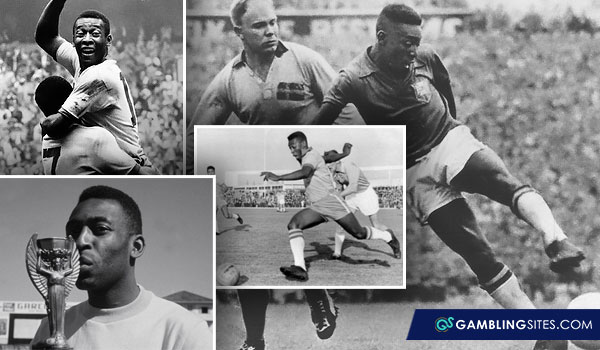
The 1958 World Cup will always be remembered as Pelé’s tournament. At just 17 years and 249 days, the Brazilian became the youngest player to both play and score in a World Cup final – bagging two goals in Brazil’s 5-2 final triumph over host nation Sweden.
Just Fontain etched his name into the history books, too, setting the record for most goals scored in a single World Cup. The Frenchman netted 13 goals in just six games, finishing seven goals clear of his nearest challengers.
1962 – Brazil Triumphs Again
- Host: Chile
- Winner: Brazil
- Number of Teams: 16
- Top Scorer: 6 players (4 nations) – 5 goals
- Average Attendance: 27,911
Brazil became the second country in the history of the soccer World Cup to win back-to-back titles, defending its crown in 1962. Once again, Pelé was at the heart of the action.
The Golden Boot was shared by a record six players that year, with Brazilian stars Garrincha and Vavá among the top scorers. The 1962 tournament is also famous for Marcos Coll’s goal against the Soviet Union, which was scored directly from a corner kick.
1966 – The Three Lions Roar
- Host: England
- Winner: England
- Number of Teams: 16
- Top Scorer: Eusebio (Portugal) – 9 goals
- Average Attendance: 48,847
On home soil, England won its first and only World Cup title in 1966. Geoff Hurst netted a hat-trick in the 4-2 final victory over West Germany, becoming the only player to score three goals in a World Cup final.
Off the field, the 1966 tournament was the first World Cup to have an official logo and mascot. The new marketing initiatives paved the way for future tournaments.
1970 – Gerd Müller Scores 10
- Host: Mexico
- Winner: Brazil
- Number of Teams: 16
- Top Scorer: Gerd Müller (West Germany) – 10 goals
- Average Attendance: 50,124
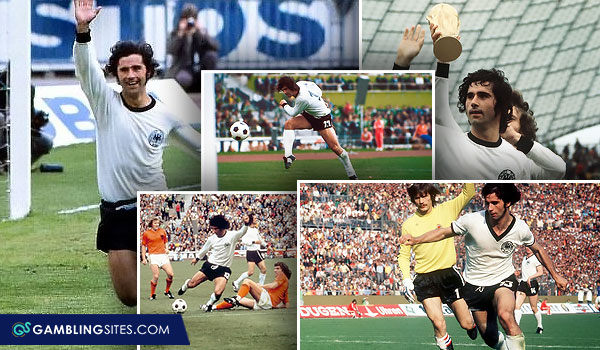
Brazil became the first team to claim three World Cup titles in 1970, while Pelé became the first and only player to win three titles. Gerd Müller starred throughout the competition, though, bagging ten goals for West Germany.
At the end of the tournament, the original Jules Rimet trophy was permanently awarded to Brazil. The new FIFA World Cup trophy would be awarded to future champions.
1974 – A New Trophy
- Host: West Germany
- Winner: West Germany
- Number of Teams: 16
- Top Scorer: Grzegorz Lato (Poland) – 7 goals
- Average Attendance: 49,098
West Germany was the first team to win the new FIFA World Cup trophy, coming from behind to beat the Netherlands 2-1 in the 1974 final. 1970 Golden Boot winner Müller, scored the winning goal at Munich’s Olympiastadoin.
The 1974 tournament is also famous for the Netherlands’ innovative “Total Football”. This tactical system revolutionized soccer, with players operating in multiple positions.
1978 – Argentina Wins on Home Soil
- Host: Argentina
- Winner: Argentina
- Number of Teams: 16
- Top Scorer: Mario Kempes (Argentina) – 6 goals
- Average Attendance: 40,678
Mario Kempes fired Argentina to the first of its two World Cup titles in 1978. The Argentines beat the Netherlands 3-1 in the final at Buenos Aires’ Estadio Monumental, with Kempes bagging a brace.
The eleventh World Cup saw the host nation win for the fifth time. However, only one host nation has lifted the trophy in the previous ten editions for the tournament.
1982 – Expansion to 24 Teams
- Host: Spain
- Winner: Italy
- Number of Teams: 24
- Top Scorer: Paolo Rossi (Italy) – 6 goals
- Average Attendance: 40,571
The 1982 World Cup featured 24 nations for the first time, with the group stage comprising six groups of four teams. Italy overcame West Germany in the final to pick up its third World Cup title, moving level with Brazil on the all-time leaderboard.
Italy legend Paolo Rossi clinched the Golden Boot, scoring six goals. Legendary names such as Karl-Heinz Rummenigge, Zico, and Falcão also announced themselves on the international stage.
1986 – Maradona’s “Hand of God”
- Host: Mexico
- Winner: Argentina
- Number of Teams: 24
- Top Scorer: Gary Lineker (England) – 6 goals
- Average Attendance: 46,039
Arguably the most infamous World Cup moment of all time, Maradona’s “Hand of God” happened at the 1986 World Cup. The iconic Argentine controversially scored with his hand in the quarter-finals against England before scoring the “Goal of the Century” in the same game.
Argentina went on to lift the trophy, beating West Germany 3-2 in Mexico City. Although Maradona chalked up five goals and five assists, England’s Gary Linker won the Golden Boot with six goals.
1990 – West Germany Wins in Italy
- Host: Italy
- Winner: West Germany
- Number of Teams: 24
- Top Scorer: Salvatore Schillaci (Italy) – 6 goals
- Average Attendance: 48,388
Following back-to-back final defeats, West Germany finally won the World Cup for a third time in 1990. The West Germans beat defending champion Argentina in Rome thanks to a last-gasp Andreas Brehme penalty.
The 1990 tournament also saw the United States return to the World Cup stage for the first time in 40 years, having previously qualified for the competition all the way back in 1950.
1994 – The US Breaks Attendance Records
- Host: United States
- Winner: Brazil
- Number of Teams: 24
- Top Scorer: Hristo Stoichkov (Bulgaria), Oleg Salenko (Russia) – 6 goals
- Average Attendance: 68,991
After returning to the World Cup four years prior, the US hosted the tournament in 1994. Brazil won its fourth title in the States, while England, Scotland, Wales, and Northern Ireland were all non-qualifiers.
To this day, the 1994 tournament holds the World Cup attendance records. 3.6 million spectators attended the competition, creating an average attendance of 68,991 per match.
1998 – Expansion to 32 Teams
- Host: France
- Winner: France
- Number of Teams: 32
- Top Scorer: Davor Suker (Croatia) – 6 goals
- Average Attendance: 43,517
In 1998, the World Cup expanded from 24 to 32 countries. The 32-team format has remained the same ever since, featuring eight groups of four teams before the knockout phase.
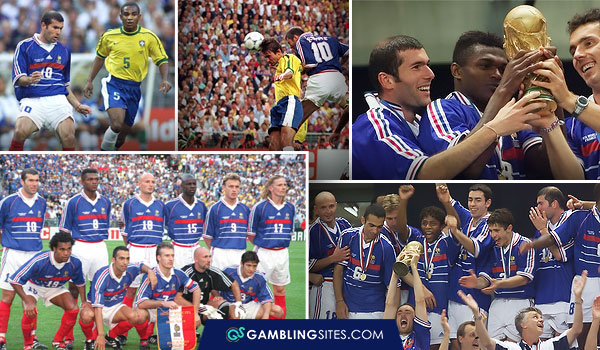
France won seven straight games on its way to lifting its maiden trophy on home soil, dispatching defending Brazil 3-0 in the Paris final. Iconic midfielder Zinedine Zidane bagged a brace in the final before Emmanuel Petit put the icing on the cake.
2002 – First World Cup in Asia
- Host: Japan/South Korea
- Winner: Brazil
- Number of Teams: 32
- Top Scorer: Ronaldo (Brazil) – 8 goals
- Average Attendance: 42,268
The 2002 World Cup was the first to be held in Asia, with Japan and South Korea co-hosting the tournament. The South Koreans stunned everyone by reaching the semi-finals, yet they were unable to prevent Brazil from clinching a record fifth title.
The competition has since been criticized for a number of questionable refereeing decisions. South Korea has faced allegations of corruption following favorable decisions in matches against Portugal, Italy, and Spain.
2006 – Zidane’s Infamous Headbutt
- Host: Germany
- Winner: Italy
- Number of Teams: 32
- Top Scorer: Miroslav Klose (Germany) – 5 goals
- Average Attendance: 52,491
In years gone by, the winner of the previous World Cup received a bye into the next tournament. But a rule change ahead of the 2006 World Cup meant the reigning champions now had to qualify for the upcoming competition.
Defending champion Brazil fell in the quarter-finals, while Italy beat France on penalties in the final. In his last professional game as a player, France legend Zinedine Zidane was sent off for headbutting Italy defender Marco Materazzi.
2010 – The World Cup Visits Africa
- Host: South Africa
- Winner: Spain
- Number of Teams: 32
- Top Scorer: 4 players (4 nations) – 5 goals
- Average Attendance: 49,669
The continent of Africa hosted the World Cup for the very first time in 2010, with South Africa staging the nineteenth edition of the tournament. A record six African nations participated, although Ghana was the only one to reach the quarter-finals.
After winning the 2008 European Championship, Spain won its first World Cup two years later. Vincente del Bosque’s famous team also went on to win Euro 2012, sealing three successive major tournament triumphs to mark an era of dominance.
2014 – Germany Thrashes Brazil 7-1
- Host: Brazil
- Winner: Germany
- Number of Teams: 32
- Top Scorer: James Rodriguez (Colombia) – 6 goals
- Average Attendance: 52,918
The 2014 World Cup will always be remembered for Germany’s phenomenal 7-1 crushing of host nation Brazil in the semi-finals. The Brazilians fell apart in front of an astonished home crowd in Belo Horizonte, while the Germans reveled in the glory.
Colombia’s James Rodriguez burst onto the scene in style, scoring six goals en route to clinching the Golden Boot. Mario Götze was the real hero, though, netting the extra-time winner in Germany’s final victory over Argentina.
2018 – France Triumphs in Russia
- Host: Russia
- Winner: France
- Number of Teams: 32
- Top Scorer: Harry Kane (England) – 6 goals
- Average Attendance: 47,371
France hammered Croatia 4-2 in the final of the 2018 World Cup to claim its second title. Antoine Griezmann and Kylian Mbappé both scored in the final round, ending the competition with four goals apiece.
The tournament was hosted in Russia for the first time. In total, 169 goals were scored across 64 matches – averaging 2.64 goals per game. England’s Harry Kane won the Golden Boot, notching six goals.
2022 — Argentina Dethrones France on Penalties
- Host: Qatar
- Winner: Argentina
- Number of Teams: 32
- Top Scorer: Kylian Mbappé (France) — 8 goals
- Average Attendance: 53,191
Kylian Mbappé scored the first-ever hat trick in a World Cup Final, but France ended extra time in a 3–3 tie with Argentina. The latter won 4–2 on penalties.
It was Argentina’s first World Cup title since 1986 and the first time a team outside of Europe won since 2002. Qatar was the first country in the Middle East and the Arabian Peninsula to host the World Cup. There were 172 total goals scored, averaging 2.69 goals per match, and Mbappé’s hat trick helped him win the Golden Boot with eight total goals.
2026 — Spain Bests Argentina In Extra Time
- Host: USA, Canada, and Mexico
- Winner: Spain
- Number of Teams: 48
- Top Scorer: Kylian Mbappé (France) — 10 goals
The 2026 World Cup delivered several firsts: an expanded 48-team format, a repeat Golden Boot winner in Kylian Mbappé, and Lionel Messi and Cristiano Ronaldo each reaching a 6th World Cup appearance. Iconic moments included the Ghana Witch Doctor cursing his country’s opponents and walkability issues at certain host cities. But the real history was made in the final between Spain and Argentina.
Argentina reached back-to-back finals as defending champions but couldn’t match Spain’s quality, falling 1-0. Spain controlled the match with 68% possession, 20 shots to Argentina’s 3, and 803 completed passes against Argentina’s 445. The scoreline was close, but the performance gap wasn’t.
History of Betting on the World Cup
Considering soccer is world’s most popular sport, the FIFA World Cup is arguably the biggest sporting event on the planet. Every four years, billions of soccer fans – and non-soccer fans – watch the tournament.
To put things into perspective, a whopping 3.2 billion television viewers tuned in to watch the 2014 World Cup final between Germany and Argentina. That was almost 50% of the world’s population at the time!
Naturally, the World Cup is also hugely popular from a betting standpoint. And with more and more top online sports betting sites emerging, World Cup betting is only going to become more popular.
Betting on the World Cup has never been easier. With hundreds of markets available for each match, along with countless futures and props, there has never been a better time to bet on the World Cup.
FIFA World Cup Betting Facts
- The Biggest Wager in World Cup History – During the 2010 World Cup, a brave gambler bet a mammoth £417,000 ($572,000) that Germany would beat Spain in the semi-finals. The bet would have returned £800,000 ($1,098,000), but Spain ended up winning 1-0.
- Turning £100 Into £83,000 – One lucky bettor in the United Kingdom turned £100 ($138) into £83,000 ($113,900) by winning a five-fold parlay during the 2014 World Cup. The final leg of the multi bet landed when Germany beat Argentina in the final.
- Germany to Beat Brazil at 500/1 – The odds for Germany to beat Brazil 7-1 in the semi-finals of the 2014 World Cup were a colossal 500/1 (+50000). We all know what happened…
- The UK Bets £1 Billion in 2014 – In the UK alone, wagers for the 2014 World Cup broke the £1 billion ($1.4 billion) mark for the first time ever. If England had reached the knockout phase that year, the figure would have been far higher.
FIFA World Cup Best of the Best
It wouldn’t be fair to discuss the history of the World Cup without mentioning the greatest teams and players of all time.
In this section, we look at the most successful teams and players in World Cup history, covering titles, goals, appearances, and more.
Which Nation Has Won the Most World Cups?
Only eight countries have been fortunate enough to win the FIFA World Cup. Six teams have lifted the trophy more than once, while just three nations have triumphed on four or more occasions.
However, one country stands alone as the most successful team in World Cup history.
Most Successful Countries in the World Cup History
| Team | Title |
|---|---|
| Brazil | 5 |
| Germany | 4 |
| Italy | 4 |
| Argentina | 3 |
| France | 2 |
| Uruguay | 2 |
| Spain | 2 |
| England | 1 |
Having triumphed a record five times (1958, 1962, 1970, 1994, 2002), Brazil has won the most World Cup titles in history.
Germany (1954, 1974, 1990, 2014) and Italy (1934, 1938, 1982, 2006) have both lifted the trophy on four occasions. Argentina (1978, 1986, 2022) just won its third, while Spain (2010, 2026), France (1998, 2018) and Uruguay (1930, 1950) have each claimed two titles.
Meanwhile England (1966) has only won the tournament once.
Player With the Most Titles
A total of 471 players have won the World Cup over the years. Still, the legendary Pelé is the only player to have won three World Cup titles.
- Pelé (Brazil): 3
- 20 Players (3 Nations): 2
- 450 Players (8 Nations): 1
Twenty players from three countries have won two World Cups, with 12 Brazilians, seven Italians, and one Argentine, Daniel Passarella, lifting the trophy on two occasions.
450 players have won the World Cup once.
Who Is the Top Goalscorer in World Cup History?
Countless famous goalscorers have graced the World Cup stage through the years, but one man stands out from the crowd. Here are the top scorers in the history of the World Cup.
FIFA World Cup – All-Time Top Scorers
The 2026 World Cup has been a monumental tournament shaking up the goal scoring record. Messi has now captured the top spot all time after 6 World Cup appearances, netting himself 21 goals across 32 games (and counting). Meanwhile, Kylian Mbappé has cemented himself as an all-time great climbing to 2nd on the list with 19 goals across 19 games. With time on his side, Mbappé should own the record once the 2030 World Cup concludes.
| Player | Team | Goals | Games |
|---|---|---|---|
| Lionel Messi | Argentina | 21 | 32 |
| Kylian Mbappé | France | 20 | 21 |
| Miroslav Klose | Germany | 16 | 24 |
| Ronaldo | Brazil | 15 | 19 |
| Gerd Müller | West Germany | 14 | 13 |
Best Goals-Per-Game Average
Above, we detailed the top scorers in World Cup history. It’s now time to check out the players with the best goals-per-game ratios.
Best Goals-Per-Game Ratios in World Cup History
| Player | Team | Goals | Games | Goals Per Game |
|---|---|---|---|---|
| Sando Kocsis | Hungary | 11 | 5 | 2.20 |
| Just Fontaine | France | 13 | 6 | 2.17 |
| Guillermo Stabile | Argentina | 8 | 4 | 2.00 |
| Josef Hugi | Switzerland | 6 | 3 | 2.00 |
| Oleg Salenko | Russia | 6 | 3 | 2.00 |
Averaging a phenomenal 2.20 goals per game, Sando Kocsis is the most prolific scorer in the history of the World Cup. The Hungarian bagged 11 goals in five matches in 1954, winning the Golden Boot.
You probably won’t be surprised to learn that Just Fontaine sits right behind Kocsis on this particular leaderboard. The Frenchman won the Golden Boot four years after Kocsis, netting an outrageous 13 goals in six matches in 1958.
Argentina’s Guillermo Stabile, Switzerland’s Josef Hugi, and Russia’s Oleg Salenko are the only other players who average 2.00+ goals per game in the history of the tournament.
Which Team Has Featured at the Most World Cups?
Five-time champion Brazil is the only nation to have featured in every single World Cup since 1930. Including 2026, Brazil has qualified for 23 World Cups, two more than Germany (21).
- Brazil: 23
- Germany: 21
- Argentina: 19
- Italy: 18
- Mexico: 17
By qualifying for the 2022 and 2026 World Cups, Argentina (19) tied, then passed Italy (18) in the all-time rankings. Mexico rounds out the top five with 17 appearances.
World Cup Record Appearance Maker
Lionel Messi and Cristiano Ronaldo became the fifth and sixth players to play in 5 total World Cups. They joined Lothar Matthäus, Antonio Carbajal, and Rafael Marquez.
Messi led Argentina to the title and set a new record for game appearances with 26.
Most World Cup Appearances By Player
| Player | Team | Appearances | Tournaments |
|---|---|---|---|
| Lionel Messi | Argentina | 33 | 6 |
| Cristiano Ronaldo | Portugal | 27 | 6 |
| Lothar Matthäus | Germany | 25 | 5 |
| Miroslav Klose | Germany | 24 | 4 |
| Paolo Maldini | Italy | 23 | 4 |
Messi and Ronaldo made the 26-man rosters for Argentina and Portugal, respectively, and will be the first players to appear in six World Cups.
FIFA World Cup FAQ
We’ll wrap things up by answering some frequently asked questions regarding the history of the World Cup.
Who is the youngest-ever World Cup player? Has the World Cup ever been cancelled? And did a dog really find the stolen World Cup trophy?
Let’s find out.
The first World Cup took place in 1930, with Uruguay hosting the inaugural tournament.
With a record five tournament wins, Brazil is the most successful country in World Cup history.
Uruguay was the first World Cup winner, triumphing on home soil.
There was a 12-year gap between the 1938 and 1950 tournaments due to the Second World War.
The United States hosted the tournament in 1994 and will host it in 2026. However, the US has never won the World Cup.
The Jules Rimet trophy was stolen in 1966 while on display in London’s Westminster Central Hall.
Remarkably, yes! A collie called Pickles found the World Cup trophy in a hedge, seven days after the theft.
Northern Ireland’s Norman Whiteside was just 17 years and 41 days when he faced Yugoslavia at the 1982 World Cup.
At 45 years and 161 days, Egypt’s Essam El-Hadary became the World Cup’s oldest player when he faced Saudi Arabia in 2018.
We have many other useful resources for soccer enthusiasts on our site.
Our soccer blog contains lots of posts on various soccer competitions, and if you’re interested in betting on soccer be sure to check out our soccer betting guide and our soccer picks section as well.


