US Marathons Ranked by Difficulty
Marathon difficulty in the US doesn’t follow a single pattern. Some courses crush runners with thousands of feet of elevation gain, others wear them down through weather, and a few manage to do both. The difference between the hardest and easiest marathons in the country is enormous — and it’s not always where you’d expect.
To measure this, we ranked every state’s most iconic marathon using a composite difficulty score built from elevation gain, average finish times, finish rates, and attendance. The result is a clear picture of where runners face the toughest tests in the country, and which courses are best for a PB.
Key Findings:
- With 3,285 feet of elevation gain nearly double the next closest race and only an 85% finish rate, Alaska’s Equinox Marathon is the hardest marathon in the United States.
- The Honolulu Marathon has the slowest average finish time and the lowest finish rate of any marathon in the country, despite being relatively flat.
- The Fargo Marathon in North Dakota is the most beginner-friendly marathon in the US, with just 120 feet of elevation and a 95% finish rate.
The Hardest and Easiest Marathons in America
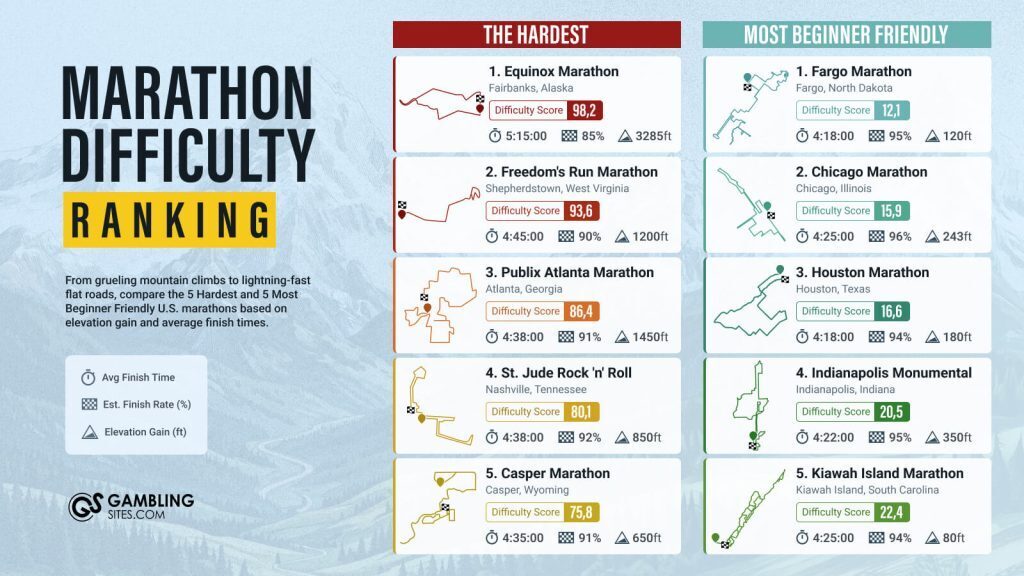
The gap between the hardest and easiest marathons in America is staggering. From 3,285 feet of elevation gain and an 85% finish rate in Alaska, to just 120 feet and a 95% finish rate in North Dakota. Below, you’ll see the five toughest and five most beginner-friendly races in the country.
The Hardest U.S. Marathons
The toughest marathons in the United States earn their spots through punishing elevation points, extreme conditions, or unusually low finish rates. These aren’t races you show up to underprepared, they demand months of targeted training and a serious respect for the course.
#1 Equinox Marathon — Fairbanks, Alaska
Founded in 1963 by University of Alaska Fairbanks skiers who literally cleared the trail themselves (even a bear encounter on Ester Dome wasn’t enough to stop them), the Equinox Marathon is one of the oldest marathons in the United States. The course summits Ester Dome twice, climbing a brutal 3,285 feet through birch and spruce forest on a mix of dirt roads and single track. An 85% finish rate and a 5:15:00 average finish time confirm what only around 400 finishers per year already know: this isn’t a road race with trail sections, it’s a mountain run that happens to be 26.2 miles.
#2 Freedom’s Run Marathon — Shepherdstown, West Virginia
Freedom’s Run is the only marathon in the country that passes through three National Park lands in a single race. Harpers Ferry, the C&O Canal, and Antietam National Battlefield. The first half is deceptively manageable, around 13 miles of flat running along the canal towpath. However, at mile 16 the course climbs the notorious Millers Sawmill Road into Antietam’s rolling, cross-country grass paths. With 1,200 feet of elevation gain, a 4:45:00 average finish time, and just 400 finishers, the race organizers are upfront: this course is “not designed for a personal record.”
#3 Publix Atlanta Marathon — Atlanta, Georgia
Ask any runner who’s done Atlanta and you’ll hear the same thing: “Hills. Hills. Hills.” There are virtually no flat sections on this course. It’s just a constant series of rolling climbs through Buckhead, Midtown, and past the Olympic rings at Cheney Stadium. The infamous stretch from miles 18–21 through North Druid Hills and Virginia Highlands is where the race gets truly brutal, with 1,450 feet of total elevation gain grinding down even well-prepared runners. A 91% finish rate and 4:38:00 average time across 3,500 finishers make it one of the hardest big-city marathons in the country.
#4 St. Jude Rock ‘n’ Roll Nashville Marathon — Nashville, Tennessee
Live bands, cheer zones, and a finish inside Nissan Stadium give Nashville a party atmosphere, but the course doesn’t play along. The first half rolls through the Belmont-Hillsborough and 12 South neighbourhoods before a long, grinding climb after crossing the Cumberland River that catches runners off guard. Then come three steep hills through Shelby Park in the final miles, packing 850 feet of total elevation gain into a course that runners consistently warn is far hillier than the official elevation profile suggests. A 4:38:00 average time and 92% finish rate across 4,500 finishers back that up.
#5 Casper Marathon — Casper, Wyoming
Started in 2002 by a local running group called the Windy City Striders, the Casper Marathon sits at 5,310 feet and throws 650 feet of elevation gain, open-plains wind, thin air and a 91% finish rate. The first half packs in the biggest climbs with little shade, while the second half follows the North Platte River Parkway. June race-day temperatures have been known to push past 90°F with zero cloud cover, and with the smallest field of any marathon we ranked, this is a race that attracts runners who know exactly what they’re signing up for.
The Most Beginner Friendly U.S. Marathons
Beginner US marathons inevitably attract more runners. These events have gentle elevation profiles, steady conditions, and consistent finish rates, making them ideal for first-time marathoners or anyone chasing a PB on a forgiving course.
#1 Fargo Marathon — Fargo, North Dakota
Running since 2005, the Fargo Marathon bills itself as a “26.2-mile party” — and the course backs up the hype. The route is so flat that there’s only 30 feet of difference between the high and low points, with live bands and DJs lining the streets through Fargo-Moorhead’s neighbourhoods and parks along the Red River. With just 120 feet of total elevation gain, a 95% finish rate, and a 4:18:00 average time, it’s the easiest marathon in the United States and a favourite for first-timers who want a fast, festive debut.
#2 Chicago Marathon — Chicago, Illinois
The Chicago Marathon is a World Marathon Major that also happens to be one of the easiest courses in the country, a rare combination. The lakefront loop carries runners through the city’s diverse neighbourhoods with just 243 feet of elevation change, and the flat terrain helps produce a 96% finish rate across a staggering 52,000 finishers. That finish rate is even more impressive given the sheer scale of the event: getting 96% of a field that large across the line speaks to how forgiving the course really is.
#3 Houston Marathon — Houston, Texas
Houston has a reputation as a course-record machine. Ryan Hall set the American half marathon record here in 2007, and course records have been broken in at least six consecutive years. The only things resembling hills in this Texas marathon are a handful of urban overpasses, with just 180 feet of elevation gain across the entire race. Mid-January weather typically delivers 45°F starts and 60°F finishes, and the race committee automatically submits finisher times to the Boston Athletic Association — making Houston one of the most efficient BQ routes in the country, with a 4:18:00 average time and 94% finish rate across 7,500 finishers.
#4 Indianapolis Monumental Marathon — Indianapolis, Indiana
Indianapolis doesn’t get the same attention as Chicago or Houston, but it arguably deserves to be in the same conversation for first-timers. The course threads past the War Memorial, Indiana State Capitol, and through the city’s tree-lined residential streets with just 350 feet of elevation gain. November temperatures keep things cool without being punishing, and the combination of a 95% finish rate, a 4:22:00 average time, and 6,500 finishers makes it one of the most accessible and well-supported marathons in the Midwest.
#5 Kiawah Island Marathon — Kiawah Island, South Carolina
Now in its 48th year, the Kiawah Island Marathon is a race unlike any other on this list. The entire course runs through a private coastal community, weaving past maritime forests, salt marshes, and live oak-lined streets that most people never get to see. With just 80 feet of elevation gain, it’s the flattest course in the country, and mild December temperatures on the South Carolina coast keep conditions comfortable. A 94% finish rate and 4:25:00 average time across 2,200 finishers make it the perfect destination race for runners who want scenery and a gentle course in one package.
Every US Marathon Ranked by Difficulty
The table below ranks all 50 state marathons from hardest to easiest, based on our composite difficulty score. Elevation gain is weighted highest at 40% because it is the strongest single predictor of physical difficulty — followed by average finish time and finish rate at 25% each.
| Rank | Marathon | State | Elevation Gain (ft) | Avg. Finish Time | Finish Rate (%) | Difficulty Score |
| 1 | Equinox Marathon | Alaska | 3,285 | 5:15:00 | 85 | 98.2 |
| 2 | Freedom’s Run Marathon | West Virginia | 1,200 | 4:45:00 | 90 | 93.6 |
| 3 | Publix Atlanta Marathon | Georgia | 1,450 | 4:38:00 | 91 | 86.4 |
| 4 | St. Jude Rock ‘n’ Roll Nashville Marathon | Tennessee | 850 | 4:38:00 | 92 | 80.1 |
| 5 | Casper Marathon | Wyoming | 650 | 4:35:00 | 91 | 75.8 |
| 6 | Clarence DeMar Marathon | New Hampshire | 950 | 4:30:00 | 93 | 74.3 |
| 7 | Little Rock Marathon | Arkansas | 750 | 4:35:00 | 92 | 73.5 |
| 8 | Cincinnati Flying Pig Marathon | Ohio | 920 | 4:35:00 | 93 | 72.5 |
| 9 | Honolulu Marathon | Hawaii | 580 | 5:30:00 | 82 | 70.8 |
| 10 | Big Sur International Marathon | California | 1,660 | 4:45:00 | 95 | 69.2 |
| 11 | Louisville Marathon | Kentucky | 650 | 4:32:00 | 92 | 67.8 |
| 12 | Newport Marathon | Rhode Island | 680 | 4:32:00 | 93 | 66.5 |
| 13 | Delaware Marathon | Delaware | 520 | 4:32:00 | 91 | 65.7 |
| 14 | Baltimore Running Festival Marathon | Maryland | 750 | 4:30:00 | 93 | 61.8 |
| 15 | St. Louis Marathon | Missouri | 680 | 4:30:00 | 93 | 60.0 |
| 16 | Maine Marathon | Maine | 820 | 4:28:00 | 94 | 59.6 |
| 17 | Mississippi Gulf Coast Marathon | Mississippi | 180 | 4:40:00 | 91 | 58.5 |
| 18 | Vermont City Marathon | Vermont | 750 | 4:25:00 | 93 | 57.5 |
| 19 | Mesa Marathon | Arizona | 1,450 | 4:22:00 | 94 | 57.0 |
| 20 | Duke City Marathon | New Mexico | 480 | 4:28:00 | 92 | 55.3 |
| 21 | Rocket City Marathon | Alabama | 580 | 4:28:00 | 93 | 54.1 |
| 22 | New York City Marathon | New York | 810 | 4:35:00 | 97 | 51.5 |
| 23 | Route 66 Marathon | Oklahoma | 520 | 4:30:00 | 93 | 51.5 |
| 24 | Revel Sun Valley Marathon | Idaho | 800 | 4:10:00 | 94 | 48.7 |
| 25 | Las Vegas Marathon | Nevada | 350 | 4:35:00 | 93 | 48.2 |
| 26 | Hartford Marathon | Connecticut | 680 | 4:25:00 | 94 | 46.5 |
| 27 | Run Oak Island Marathon | North Carolina | 150 | 4:35:00 | 93 | 46.3 |
| 28 | Seattle Marathon | Washington | 650 | 4:28:00 | 94 | 45.7 |
| 29 | Louisiana Marathon | Louisiana | 180 | 4:35:00 | 93 | 45.3 |
| 30 | Prairie Fire Marathon | Kansas | 320 | 4:30:00 | 93 | 45.2 |
| 31 | Walt Disney World Marathon | Florida | 150 | 5:30:00 | 93 | 44.2 |
| 32 | Philadelphia Marathon | Pennsylvania | 822 | 4:20:00 | 95 | 41.6 |
| 33 | Milwaukee Marathon | Wisconsin | 380 | 4:25:00 | 93 | 41.2 |
| 34 | Detroit Free Press Marathon | Michigan | 350 | 4:28:00 | 93 | 38.6 |
| 35 | Des Moines Marathon | Iowa | 380 | 4:28:00 | 94 | 37.7 |
| 36 | Denver Marathon | Colorado | 450 | 4:20:00 | 93 | 36.7 |
| 37 | Marine Corps Marathon | Virginia | 480 | 4:32:00 | 95 | 36.4 |
| 38 | Lincoln Marathon | Nebraska | 420 | 4:25:00 | 94 | 36.3 |
| 39 | Missoula Marathon | Montana | 550 | 4:22:00 | 95 | 34.2 |
| 40 | Twin Cities Marathon | Minnesota | 620 | 4:18:00 | 94 | 34.1 |
| 41 | Atlantic City Marathon | New Jersey | 120 | 4:32:00 | 94 | 32.9 |
| 42 | Boston Marathon | Massachusetts | 780 | 3:53:00 | 97 | 30.9 |
| 43 | Portland Marathon | Oregon | 380 | 4:22:00 | 94 | 28.6 |
| 44 | Brookings Marathon | South Dakota | 280 | 4:20:00 | 94 | 28.5 |
| 45 | St. George Marathon | Utah | 580 | 4:08:00 | 96 | 23.7 |
| 46 | Kiawah Island Marathon | South Carolina | 80 | 4:25:00 | 94 | 22.4 |
| 47 | Indianapolis Monumental Marathon | Indiana | 350 | 4:22:00 | 95 | 20.5 |
| 48 | Houston Marathon | Texas | 180 | 4:18:00 | 94 | 16.6 |
| 49 | Chicago Marathon | Illinois | 243 | 4:25:00 | 96 | 15.9 |
| 50 | Fargo Marathon | North Dakota | 120 | 4:18:00 | 95 | 12.1 |
Methodology
To build a clear, data‑led picture of marathon difficulty across the U.S., we ranked each state’s most iconic marathon using a composite scoring system. Every score is built from publicly available data and normalized through a percentile‑based system to keep comparisons fair across states with very different course profiles and conditions.
How Marathons Were Selected
One marathon was chosen for each state based on the event’s reputation, established history, and the availability of reliable race data like finisher counts, course profiles, and timing recordings. For example, in Massachusetts, Illinois, and New York, the World Marathon Majors were selected due to their global prestige.
How We Scored Marathon Difficulty
Four factors were scored for difficulty:
- Elevation gain (40%) — the strongest single predictor of physical difficulty, due to its measurability and consistency
- Average finish time (25%) — slower average times indicate a more demanding course
- Finish rate (25%) — a lower finish rate implies a harder course, as fewer starters cross the line
- Attendance (10%) — smaller fields often mean less infrastructure and crowd support, adding to the challenge
Elevation gain is weighted highest at 40% because it is the strongest single predictor of physical difficulty. Average finish time and finish rate help capture race‑day performance trends, while attendance reflects the scale of the race and how much support it gets from runners, despite its difficulty.
For deeper accuracy, the effort required on the course elevation is measured as total cumulative climbing not net change – meaning every uphill segment is added, rather than just measuring starting height against finishing height.
Data Sources
- Marathon selection: RaceRaves Best Marathons in the U.S. (2025 poll); MarathonGuide.com; FindMyMarathon.com; RunningWithRock.com finisher analysis
- Finisher counts: MarathonGuide.com race results; RunningWithRock.com 2024 finisher analysis; individual race websites
- Finish rates: MarathonGuide.com where available; estimated at 88–97% based on race type and historical norms
- Elevation gain: FindMyMarathon.com course profiles; Statathon.com marathon analysis; individual race course maps
- Average finish time: MarathonGuide.com race results; individual race results pages
Summary
The data shows that the hardest US marathons and the easiest ones are separated by an enormous gap. Alaska’s Equinox Marathon demands elite preparation with thousands of feet of climbing and an 85% finish rate, while courses like the Fargo Marathon offer flat, forgiving terrain where nearly everyone crosses the finish line.
What’s particularly interesting is that difficulty doesn’t always align with prestige or city size. The Honolulu Marathon — held in a world-famous destination — ranks #9 for difficulty, not because of its elevation, but because of its heat and wide-open entry policy. Meanwhile, the Boston Marathon ranks just #42 despite its legendary status, because its qualifying standards produce a field so fast that the average finish time is 3:53:00 — the fastest in the country.
On the flip side, some major-city races like Chicago (#49) and Houston (#48) rank among the easiest, combining flat courses with massive crowd support and high finish rates. Big doesn’t always mean brutal.
Whether you’re looking for your first marathon or hunting for a course that will truly test your limits, the rankings above should help you choose a race that matches your preparation. And if you want to know where to train for it, check out our ranking of the best US cities for marathon training.