Gambling Tax by State: Where a $1 Million Casino Win Costs You the Most (2026)
A $1 million casino win doesn’t mean $1 million in your pocket. Part of it is already spoken for, and where you live decides how much stays. This gambling tax by state analysis reveals what makes it through intact, based on a single filer using the standard deduction under the 2024 framework. We look at two setups: the win as the only income, and the same payout on top of a median salary. The gap is huge, with up to $426,923 gone. Hawaii carries the heaviest burden, while nine states take nothing at the local level.
Ranking US States with the Highest Gambling Taxes
Federal US gambling laws treat casino winnings as taxable income. No matter where you are, $322,786 is gone from a $1 million win, straight into the US Treasury. Then you’ve got state taxes, where the gap between top-end Hawaii and the zero-tax states stretches to $104,137.
Here’s a closer look at the places with the highest state tax on gambling winnings, followed by those that take nothing, and how the two sides compare.
Hawaii
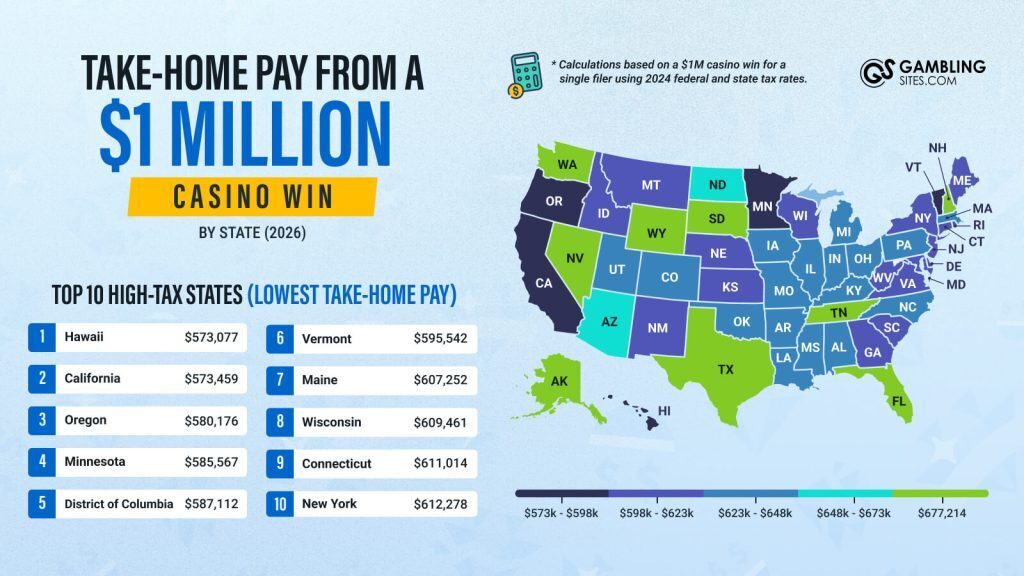
Hawaii tops the list for state tax on gambling winnings. You would owe $426,923 out of a $1 million win, with $573,077 left at a 42.69% effective rate. State charges alone account for $104,137 under a progressive system that climbs to 10.41%. That remaining sum covers about 10.3 years at median income, yet only 5.7 years of living costs, given the high expenses.
California
The California state tax on gambling winnings comes out at an effective 10.38%, or $103,755 on a $1 million win, with total tax rising to $426,541 — a 42.65% overall rate — leaving $573,459. The top bracket reaches 13.3%, including a 1% mental health surcharge. Compared with Hawaii, gambling in California faces a higher top tax rate at 13.3%, though in this $1M scenario, the Aloha State still takes slightly more overall.
Oregon
Ranked at spot number 3 is Oregon. A 9.70% state take translates to $97,038, which, once the $322,786 federal share is factored in, brings the total bill to $419,824. The local tax system is progressive, though only tops out at 9.9%, much lower than that of California. Given the $60,430 median salary, the remaining $580,176 from a $1 million win works out to about 9.6 years of pay, just a step behind Hawaii among the top five.
Minnesota
A $1 million win in Minnesota stretches to about 9.6 years when covering living costs. In terms of state tax on gambling winnings, this is about as good as it gets at the harsher end. You would take home $585,567 — $1,545 less than the District of Columbia, yet it stretches further in real terms, given that everyday expenses come in about $30,000 lower per year. The state liability stands at $91,647, shaped by rates up to 9.85% and a larger standard deduction ($14,575 vs the $2,200 and $2,420 in Hawaii and Oregon).
District of Columbia
D.C. residents are the hardest crowd to impress with a $1 million casino win. Though not without reason. The District of Columbia leads the country in median pay ($88,370). A $587,112 payout, after deducting $90,102 in state tax and a further $322,786 for federal, equals 6.6 years’ worth of wages. The state’s effective rate is 9.01%, under a progressive system that rises to 10.75%.
States with $0 State Income Tax
Across the 50 US states and the District of Columbia, nine jurisdictions have no state tax on gambling winnings. These are Alaska, Florida, New Hampshire, South Dakota, Tennessee, Texas, Washington, Wyoming, and Nevada. The latter is perhaps the most iconic of the lot, considering how closely it’s tied to casino culture.
On a $1 million gambling win, you’d owe $322,786 in federal tax, leaving a maximum take-home of $677,214. That is more than $100,000 ahead of places like Hawaii or California. The difference really shows in places like South Dakota, where that remaining money could keep you off work for about 13 years and 11 months and cover living costs across roughly 13 and a half years.
Scenario Assumptions
All figures above are based on a scenario where an individual reports $1,000,000 in gambling winnings as their sole income for the tax year. We also include a second view in the embedded Flourish table where the same payout is combined with each location’s median income to show how the total tax liability changes when additional earnings are taken into account.
Gambling Tax by State Comparison Table
Take a look at the table below for the key numbers laid out together.
| Location | State Eff. Rate | State Tax Owed | Total Tax Owed | Take-Home |
|---|---|---|---|---|
| Hawaii | 10.41% | $104,137 | $426,923 | $573,077 |
| California | 10.38% | $103,755 | $426,541 | $573,459 |
| Oregon | 9.70% | $97,038 | $419,824 | $580,176 |
| Minnesota | 9.16% | $91,647 | $414,433 | $585,567 |
| District of Columbia | 9.01% | $90,102 | $412,888 | $587,112 |
| No State Income Tax States | 0.00% | $0 | $322,786 | $677,214 |
Methodology
To get a clear picture of gambling taxes by state across the US, we pulled together data from the following sources:
- IRS federal income tax brackets and guidance
- State income tax rates and official state tax authority publications
- Bureau of Labor Statistics OEWS May 2023 wage data
- MERIC and BLS cost-of-living data
We then modelled a $1 million casino win using a single filer with the standard deduction under 2024 tax rules. The setup covered two cases, one where the win was the only income, and another with the same payout alongside a median salary. For each state, we applied its tax structure, including progressive rates and any surcharges.
You can find a Flourish table embedded below with the full dataset for transparency and further exploration.
Gambling Tax by State Summary
A $1 million casino win sees about $322,786 taken in federal income tax, calculated across progressive brackets from 10% up to 37% after applying the standard deduction. The only thing that changes based on location is state tax. The toughest ones, like Hawaii and California, strip out another ~$100,000. Once you factor in higher living costs, that gap can work out to about eight years less in spending power compared to somewhere like South Dakota.