Most Coupon-Obsessed States in the U.S.
Few things unite Americans quite like a good coupon. Reports suggest that 93% of consumers use them for household purchases, and their grip on consumer spending is strong enough that JCPenney lost $4 billion after abandoning its coupon strategy in 2012. The phenomenon has also produced a $40 million fraud ring, later immortalized in the 2018 CBS documentary Pink Collar Crimes and the film Queenpins about three years after.
These days, however, savings seekers are more likely to use browser extensions, promo-code databases, cashback apps, and casino sign-up offers rather than newspaper clippings. To see where the appetite for a deal is strongest, we analyzed Google Trends data across 15 coupon-related search terms in every state.
Key Findings
- Wyoming is America’s coupon capital. Not New York or California. The nation’s least-populated state searches for promo codes, cashback apps, and online deals more than anywhere else.
- West Virginians search for gambling promo codes nearly 50% more than residents of any other state. The state was one of America’s earliest adopters of legal online casinos.
- Kansas ranks second overall, but it dominates digital couponing. No state searches more often for discount codes, voucher codes, and coupon apps.
- New York proves even high earners love a bargain. Among major states, New Yorkers are the heaviest users of deal platforms such as Groupon and RetailMeNot.
- Six of America’s 10 most coupon-obsessed states are in the Northeast. High living costs and a strong e-commerce culture may help explain why.
- Arizona, the home of the $40 million coupon fraud ring, places just 22nd for coupon interest today. The scheme later became the basis for Queenpins and Pink Collar Crimes.
Wyoming and Kansas Lead the Nation in Coupon Searches
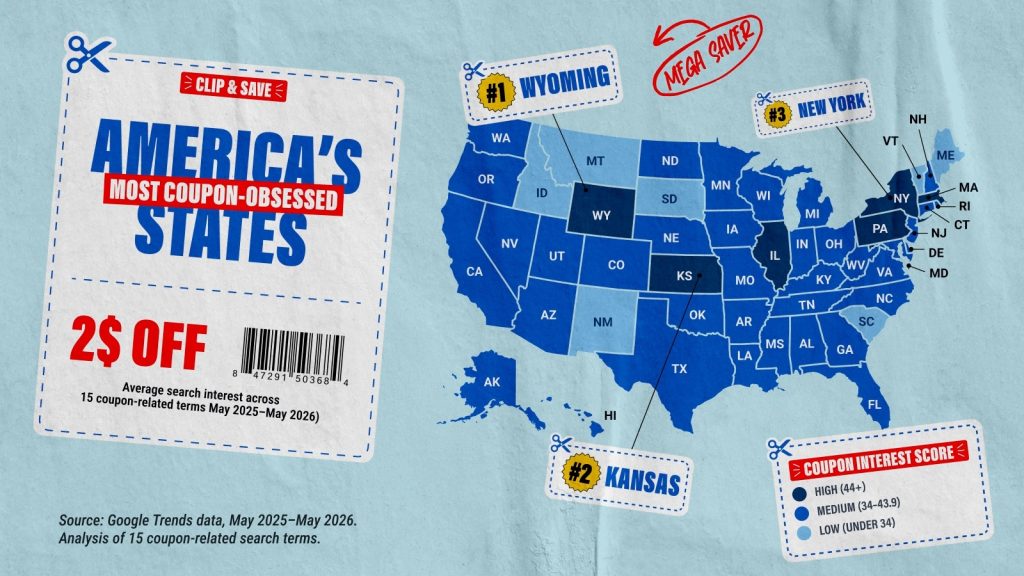
Google Trends can make small states look louder than they are. A smaller search base means one popular query can push the numbers up fast. But Wyoming and Kansas were not riding a random coupon spike. They kept showing up across the savings map, from promo codes and cashback apps to voucher searches and deal-finding tools.
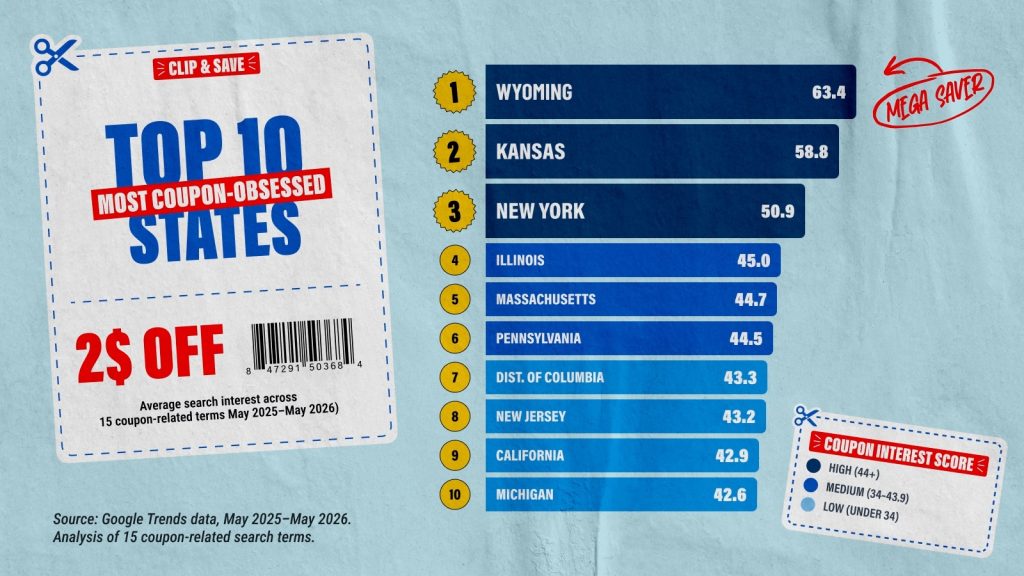
Wyoming posted the highest average score in the analysis at 63.4 across the 15 coupon-related search terms. The state recorded peak relative search interest for “promo codes,” “online coupons,” “Honey promo,” “cashback app,” and “best deals online.” Kansas occupied much of the same territory, with perfect scores for “discount codes,” “voucher codes,” and “coupon app.”
That pattern pulls back the curtain on the shopping realities of both states. Wyoming and Kansas are largely rural, and many households do not have the same access to stores found in major metro markets. When a trip to the nearest big-box chain requires planning, residents have more reason to turn online, where coupon codes and digital discounts can help stretch each dollar further.
New York and the Northeast Are America’s Coupon Corridor
Even though smaller states recorded the highest per-capita search activity, over in New York and the Northeast, dense population centers concentrate coupon interest at a scale few regions can match.
New York claimed the No. 3 spot, while Massachusetts, Pennsylvania, Washington, D.C., and New Jersey weren’t far behind in the top 10. Interest was especially strong for platform-specific searches such as ‘Groupon,’ ‘RetailMeNot,’ and ‘free shipping code,’ a sign that many residents already know exactly which wells to draw from when hunting for a deal.
One factor likely fueling the region’s appetite for coupons is the high cost of living. New York and Massachusetts both placed among the five most expensive states in the 2025 index. Dense urban populations and constant exposure to e-commerce create particularly fertile conditions for coupon use.
Casino Promo Codes Reveal a Different Kind of Deal Hunter
The bargain hunt now reaches far beyond the checkout aisle. Rising searches for terms surrounding casino promo codes show that even in entertainment spending, consumers are looking for ways to maximize value.
Notably, several of the highest-ranking states either operate established online casino industries or have expanded legal gambling options in recent years. A perfect 100 put West Virginia atop the rankings, ahead of Oklahoma, Kansas, Pennsylvania, and Delaware. Here’s a closer look at the top 10:
This is fairly typical behavior among populations newly exposed to a legalized gambling market. Online casinos launch operations, each looking to build a customer base while leaning on promotional offers for visibility. Consumers, in turn, take advantage and shop around for the best incentives before signing up.
“Extreme Couponing” Hasn’t Died — It’s Just Gone Digital
For a brief period in the early 2010s, extreme couponing felt like America’s strangest competitive sport. TLC turned grocery-store savings into prime-time television as shoppers walked away with overflowing carts after shaving hundreds of dollars off their receipts. Then came Queenpins, the 2021 film inspired by a real Arizona coupon fraud ring that allegedly generated roughly $40 million through counterfeit discounts. The scheme’s ringleaders — Robin Ramirez, Marilyn Johnson, and Amiko “Amy” Fountain — reportedly funded a lifestyle that included private jets and luxury vehicles.
The fascination never fully disappeared. Alaska, West Virginia, Iowa, Alabama, Pennsylvania, and Louisiana continue to register search interest in extreme couponing. Meanwhile, coupon stacking — the practice of combining multiple discounts on a single purchase — remains alive and well in Washington, which posted a perfect 100. Virginia, Utah, Massachusetts, New York, Connecticut, Colorado, Illinois, California, and Florida all follow with scores of 66.
True, you won’t as often find binders packed with newspaper clippings sitting beside kitchen tables. But that’s largely because browser extensions, cashback apps, automated coupon finders, and promo-code databases now handle the work. The name of the game is still squeezing every last discount out of a purchase before checking out.
The States That Don’t Bother With Coupons
America is far too large not to produce a few outliers, and in this case, the standout is Hawaii. The Aloha State recorded the lowest level of coupon interest in the country with an average score of 22.5. Montana followed at 24.3, ahead of New Mexico (29.5), Maine (30.3), and Idaho (30.5).
There are several possible explanations. Hawaii’s geographic isolation and tourism-driven economy may reduce the relevance of the digital coupon ecosystem that dominates much of the mainland. Elsewhere, several of the lowest-ranking states are defined by smaller populations and large rural areas, perhaps aided by the fact that online retail activity is less concentrated than it is in major metropolitan markets.
That doesn’t mean residents are any less interested in saving money. The data only shows lower online engagement with coupon culture. If anything, these states could be among the few places where traditional bargain hunting hasn’t fully given way to digital alternatives.
Methodology
To identify America’s most coupon-obsessed states, we analyzed Google Trends search interest data for 15 coupon- and deal-related search terms over a 12-month period between May 25, 2025, and May 25, 2026. All data was filtered to the US and breaks down the results by state.
We grouped search terms into three distinct categories:
Google Trends measures relative search interest on a scale from 0 to 100. A score of 100 goes to the state that generated the highest concentration of activity for a given term during the study period. All others receive a lower figure based on how their level compares with the top performer. These values do not show the actual number of queries submitted. Instead, they indicate how popular a topic was in one region when compared with others.
The final Coupon Obsession Score reflects the average Google Trends score across all 15 search terms for each state. Those places that did not generate sufficient Google Trends data for a particular phrase received a score of 0. We then ranked states based on their average score across the full dataset.
Conclusion
Google Trends data suggests America’s appetite for a deal is as healthy as ever. The hunt has simply moved online — promo codes, cashback apps, browser extensions, coupon platforms, and casino sign-up offers. Wyoming ranks as the country’s most coupon-obsessed state, while Kansas leads the way in digital couponing. New Yorkers proved that a higher income doesn’t mean passing up a good bargain.
As e-commerce expands, so does consumer price-consciousness, leaving shoppers more focused than ever on finding specific deals. Instead of wasting time digging around for deals, Americans are likely to devote more of it to comparing the best available offers before making a purchase.
Appendix Table
| Rank | State | Avg. Score |
|---|---|---|
| 1 | Wyoming | 63.4 |
| 2 | Kansas | 58.8 |
| 3 | New York | 50.9 |
| 4 | Illinois | 45.0 |
| 5 | Massachusetts | 44.7 |
| 6 | Pennsylvania | 44.5 |
| 7 | District of Columbia | 43.3 |
| 8 | New Jersey | 43.2 |
| 9 | California | 42.9 |
| 10 | Michigan | 42.6 |
| 11 | Utah | 42.1 |
| 12 | Connecticut | 41.7 |
| 13 | Virginia | 41.7 |
| 14 | Washington | 41.3 |
| 15 | Maryland | 41.0 |
| 16 | Colorado | 40.8 |
| 17 | Missouri | 40.7 |
| 18 | Florida | 40.3 |
| 19 | West Virginia | 40.1 |
| 20 | New Hampshire | 39.9 |
| 21 | Georgia | 39.8 |
| 22 | Arizona | 39.7 |
| 23 | Iowa | 39.5 |
| 24 | Delaware | 39.1 |
| 25 | Wisconsin | 38.8 |
| 26 | North Carolina | 38.1 |
| 27 | Ohio | 37.7 |
| 28 | Minnesota | 37.4 |
| 29 | Rhode Island | 36.1 |
| 30 | Louisiana | 36.1 |
| 31 | Nevada | 36.1 |
| 32 | Indiana | 35.6 |
| 33 | Oklahoma | 35.5 |
| 34 | Oregon | 35.4 |
| 35 | Arkansas | 35.3 |
| 36 | North Dakota | 35.1 |
| 37 | Texas | 35.1 |
| 38 | Nebraska | 34.9 |
| 39 | Alaska | 34.8 |
| 40 | Mississippi | 34.3 |
| 41 | Kentucky | 34.1 |
| 42 | Alabama | 33.7 |
| 43 | Tennessee | 33.6 |
| 44 | South Carolina | 32.3 |
| 45 | Vermont | 31.8 |
| 46 | South Dakota | 30.7 |
| 47 | Idaho | 30.5 |
| 48 | Maine | 30.3 |
| 49 | New Mexico | 29.5 |
| 50 | Montana | 24.3 |
| 51 | Hawaii | 22.5 |